After Joseph Scanes opened the medal tally with gold on day one, it was Divine Iheme who stole the headlines on the second day of the European Athletics U18 Championships in Rieti by claiming the men’s 100m title. Already regarded as one of Europe’s most exciting young sprinters after breaking multiple age-group records, the British teenager lived up to expectations in spectacular fashion, equalling his personal best of 10.29 while also setting a new championship record.
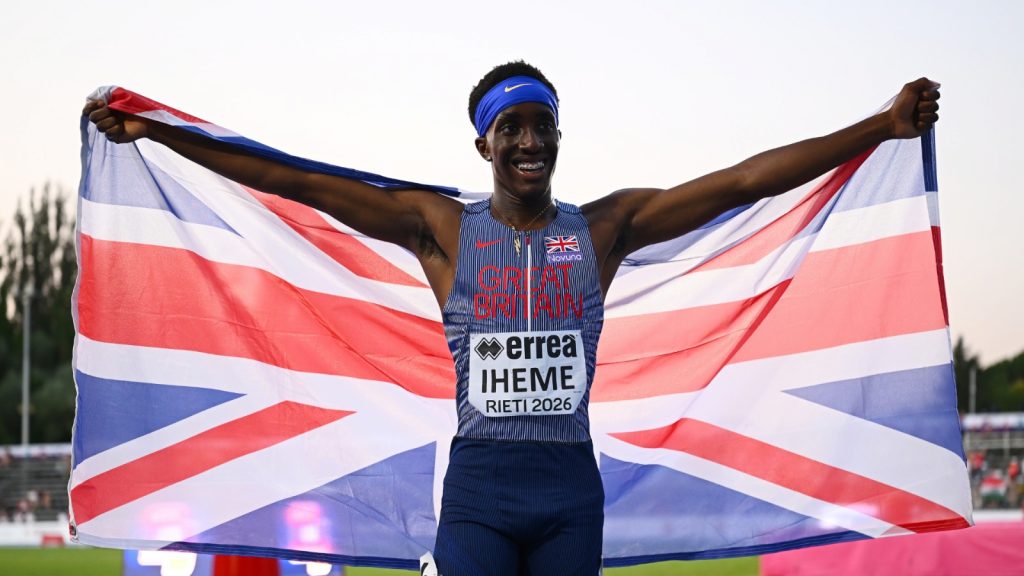
Divine Iheme claims gold and rewrites the championship record books
Even before the championships got underway, Divine Iheme was widely considered one of the leading contenders for the European U18 100m title. The British sprinter travelled to Rieti with the second-fastest European U18 performance of the season, sitting around one tenth behind French athlete Dylan Telo, who had clocked 10.29 just a few weeks earlier. Coincidentally, that was also Iheme’s personal best, set last season, suggesting there was still considerable room for improvement after an injury-disrupted start to his 2026 campaign.
From the opening heats, it quickly became apparent that Iheme was the athlete everyone else would have to beat. Looking remarkably relaxed, technically smooth and almost effortless through every phase of his race, the British youngster comfortably won his heat in an impressive 10.46. It was the sort of performance that immediately established him as the overwhelming favourite heading into both the semi-finals and the final. When the medals were on the line, Iheme delivered once again. Exploding from the blocks, he immediately established control of the race before maintaining flawless sprint mechanics all the way to the finish line. Never appearing under any real pressure, he stopped the clock at 10.29 (+0.1 m/s), equalling his lifetime best while lowering the championship record by three hundredths of a second. It was a performance worthy of a European title and secured the first major international individual gold medal of his career. Spain’s Francisco de Las Heras claimed the silver medal in 10.36, while Austria’s Marco Glinz completed the podium in 10.45, but neither athlete was able to challenge Iheme once the British sprinter had established his advantage.
Iheme’s victory also ensured the United Kingdom continued its outstanding start to the championships following Joseph Scanes’ 3000m triumph on the opening day. Combined with the large number of British athletes progressing comfortably through the heats and semi-finals across multiple disciplines. However, the second day was far from being solely about Iheme’s gold medal. In the women’s 100m, Celine Obinna-Alo added another medal to the British tally by producing an excellent run to secure bronze in 11.50. Team-mate Shivelle Marshall also enjoyed an impressive competition, setting a new personal best in the semi-finals before finishing seventh in the final.
Another standout British performance came courtesy of Ethan Heggarty in the men’s 200m. The talented sprinter stormed through his opening heat in 20.77, setting a new championship record and reinforcing his position as the clear favourite for the European title later in the competition following his outstanding performances earlier this year in Cardiff. Fellow British athlete Bronson Hearn-Smith also safely booked his place in the semi-finals, while Shaiya Kenion and Holly Ryan both progressed through the women’s 200m heats.
The middle-distance events have continued to provide excellent results for the United Kingdom. Charlie Chambers and Magnus Riddell both won their respective 800m semi-finals in convincing fashion, while Ezrah Harrold and Jorjia March safely negotiated their opening rounds. March then continued her impressive form by qualifying for the women’s 800m final with the second-fastest overall time.
Over 1500m, Freddie Rowe and Alistair Street both progressed comfortably into the final after well-controlled qualifying races. Lucas Cameron and Noa Chodokufa also booked their places in the 400m finals, although Darcy Coslett narrowly missed out despite producing another strong performance.
Traditionally, the field events have not been the strongest area for British athletes at major international championships, but Rieti has provided several encouraging signs. Leila Newth broke the British U18 triple jump record with an outstanding leap of 13.02m to qualify automatically for the final. Lucy Bull also impressed in the javelin, securing automatic qualification with a throw of 54.98m, while Alessia Scala advanced to the high jump final. Among the completed finals, Sophie Robertson delivered another excellent performance by finishing fifth in the hammer throw after improving her personal best several times throughout the competition. Emilia Adese narrowly missed out on a medal in the shot put, finishing fourth with a best effort of 16.85m.
At the end of the second day, the United Kingdom remains at the top of the medal table with two gold medals and one bronze, ahead of Germany and Italy.