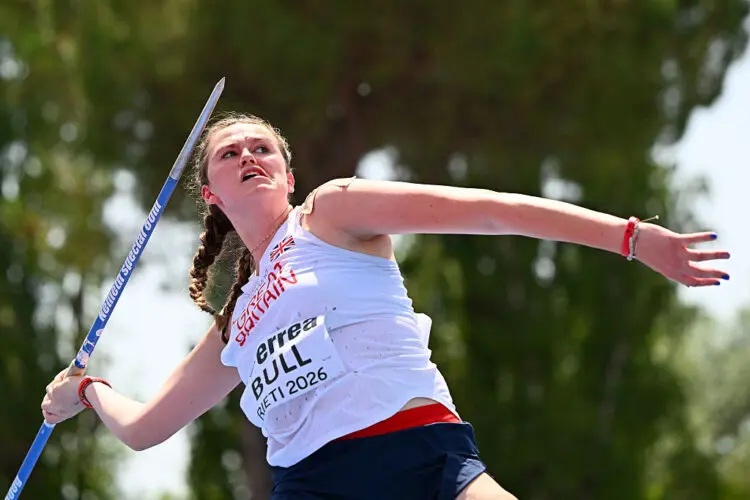
This summer, Lucy Bull and Edward Scott delivered two rare British results in the javelin at the European U18 Championships in Rieti. Bull won the women’s title with 56.60m, while Scott claimed silver in the men’s competition with 70.02m. Two medals which, on their own, are obviously not enough to herald a revival of British javelin. Yet they raise a broader question in an event where many of the leading throwers of recent years have come from countries in which cricket plays a major role : does the United Kingdom finally have a generation capable of beginning to close the gap ?
The British paradox in the face of javelin’s new powers
The pattern has gradually become increasingly apparent over recent years. Cricket alone is certainly not enough to explain it, but the sport regularly appears in the backgrounds or sporting cultures of several countries that have made their mark on world javelin. In the Caribbean, Anderson Peters and Keshorn Walcott are perhaps the clearest examples. Peters, from Grenada, became world champion in 2019 and again in 2022 before taking Olympic bronze in Paris in 2024. Walcott, from Trinidad and Tobago, caused a sensation when he won Olympic gold as early as 2012, before adding bronze in Rio four years later. In 2025, he completed his collection with the world title in Tokyo, finishing ahead of Peters – two medals for athletes from countries that, in cricket, would both fall under the West Indies banner.
South Asia has also profoundly reshaped the event’s hierarchy. India’s Neeraj Chopra won Olympic gold in 2021, followed by the world title in 2023, before taking Olympic silver in Paris in 2024. That Olympic final was won by Pakistan’s Arshad Nadeem, whose triumph confirmed that Chopra’s success was far from an isolated phenomenon. Behind those two leading figures, the emergence of another Indian thrower, Sachin Yadav, in Tokyo in 2025 provided further evidence of the depth that javelin has developed across the Indian subcontinent.
In 2026, the trend has widened further. Sri Lanka’s Rumesh Tharanga Pathirage currently heads the world rankings with 92.62m. At the same time, Ben East, Britain’s leading performer this season with 81.12m, sits more than 11 metres behind that world-leading mark. The gap does not tell the whole story, but it offers a fairly accurate picture of the current situation: the United Kingdom has competitive throwers, yet has been unable to establish one among the athletes regularly challenging for the sport’s biggest medals.
The contrast is particularly striking given British history in the event. Steve Backley remains the last British thrower to have enjoyed a sustained spell at the very top of javelin. His career in the 1990s, notably featuring three Olympic medals, two of them silver, now belongs to another era. Since then, British javelin has not regained a comparable presence at the highest international level. The situation is all the more intriguing because cricket and javelin share several fundamental qualities. They are not the same movement, and it would be wrong to reduce one to a modified version of the other. Yet both are built around a similar principle: generating speed through the whole body before progressively transferring it to the hand at the moment of release.
In both sports, then, the arm never works in isolation. The feet, legs and hips all contribute to generating speed before the trunk, shoulder, elbow and hand transfer that energy into either the ball or the javelin. This kinetic chain is particularly evident among fast bowlers in cricket – Pathirage himself was one in his younger years – who must also turn their approach and ground contact into an extremely rapid action through the upper body. Javelin naturally has its own specific demands. The run-up, body position, blocking action on the front leg and release angle all require specialist technique. Cricket, meanwhile, imposes its own constraints, most notably the requirement to deliver the ball with a straight arm and the level of accuracy needed to distinguish a good delivery from a poor one. Nevertheless, the physical and motor qualities involved overlap considerably: explosiveness, coordination, speed, power through the legs and hips, mobility and speed through the trunk and shoulder, and the ability to transfer energy at precisely the right moment of release.
That is probably why the pathway can work in both directions. An athlete developed through cricket does not automatically become a capable javelin thrower, of course, but may already possess some of the physical and technical foundations needed to learn the event. Conversely, cricket history provides several examples of athletes who began in the throwing disciplines before ultimately choosing a different sporting path.
The case of Ian Pont is particularly revealing in that respect. The former British cricketer briefly took up the javelin and, after only a few weeks of technical coaching, reached 72 metres – then the Olympic qualifying standard. Margaret Whitbread, one of the leading figures in British javelin coaching, was sufficiently impressed to say that he had “the most natural throwing arm this side of the Iron Curtain”. Pont ultimately never pursued a career in the event, with his cricket contract taking precedence over that opportunity.
That precedent gives the British paradox a particularly interesting dimension. If countries across South Asia and the Caribbean, where cricket forms an important part of sporting culture, are now producing several world-class javelin throwers, why has the United Kingdom – the historical home of cricket – struggled to turn a comparable talent pool into sustained success in the event?
Lucy Bull and Edward Scott : two international medals that raise a genuine question
The results in Rieti do not yet answer that question. They do, however, give the United Kingdom two very concrete reasons to ask it. At this summer’s European U18 Championships, British javelin produced something that had not been seen for a long time: two medals, one gold and one silver.
Edward Scott had already demonstrated his consistency before the championships. With 72.38m, he ranked fourth in the world U18 lists for the year going into Rieti and was among the leading contenders for a medal. In the final, he threw 70.02m to take silver behind Finland’s Jere Murto, the world leader, whose outstanding 80.41m proved beyond reach. Scott’s medal was therefore no great surprise, but rather confirmation that he genuinely belongs among the leading throwers in his age group.
Lucy Bull’s case, however, is even more closely connected to the wider question surrounding British javelin. She arrived in Rieti with the sixth-best U18 performance in the world that year. Once there, she raised her level when it mattered: first throwing 54.98m in qualifying before reaching 56.60m in the final, an overall improvement of 2.57m on her personal best over the course of the championships. In doing so, she became the first British athlete to win the European U18 title in the event. But Bull is not simply a javelin specialist. She also has a high-level background in cricket, including a call-up to the Glamorgan Academy, selection in Gloucestershire’s women’s squad and a place on the Gloucestershire Elite Player Pathway. After winning her European title, she explained that she had stopped playing cricket this year to focus on javelin, while acknowledging that the two sports could help one another. That dual sporting background makes her a particularly fascinating case. On the one hand, her experience in cricket may have helped develop qualities useful for javelin. On the other, it illustrates the risk facing a less prominent sport: that an athlete with exceptional natural throwing ability may ultimately choose another career.
The story of Deandra Dottin is a reminder that this is a very real possibility. Before becoming one of the leading figures in West Indies cricket, the Barbadian had achieved international success in several throwing events, including the javelin. Her sporting career subsequently turned decisively towards cricket. Pont and Dottin represent two very different stories, but both underline the same reality: possessing a natural talent for throwing does not guarantee that an athlete will remain in athletics.
Bull’s decision to put cricket on hold in 2026 in favour of javelin therefore carries a significance beyond her individual case. It shows that a British athlete with a profile capable of succeeding in both sports can, at least for the moment, choose javelin. Perhaps the real challenge for the United Kingdom is not to search for one single explanation for its current deficit. A cricketing culture does not automatically produce javelin champions. It can, however, provide an environment in which some of the qualities particularly valuable for throwing are already being developed. The task is then to identify those profiles, give them the conditions and specialist support required to progress and, above all, prevent the most promising talents from routinely leaving athletics before discovering just how far their potential might take them.