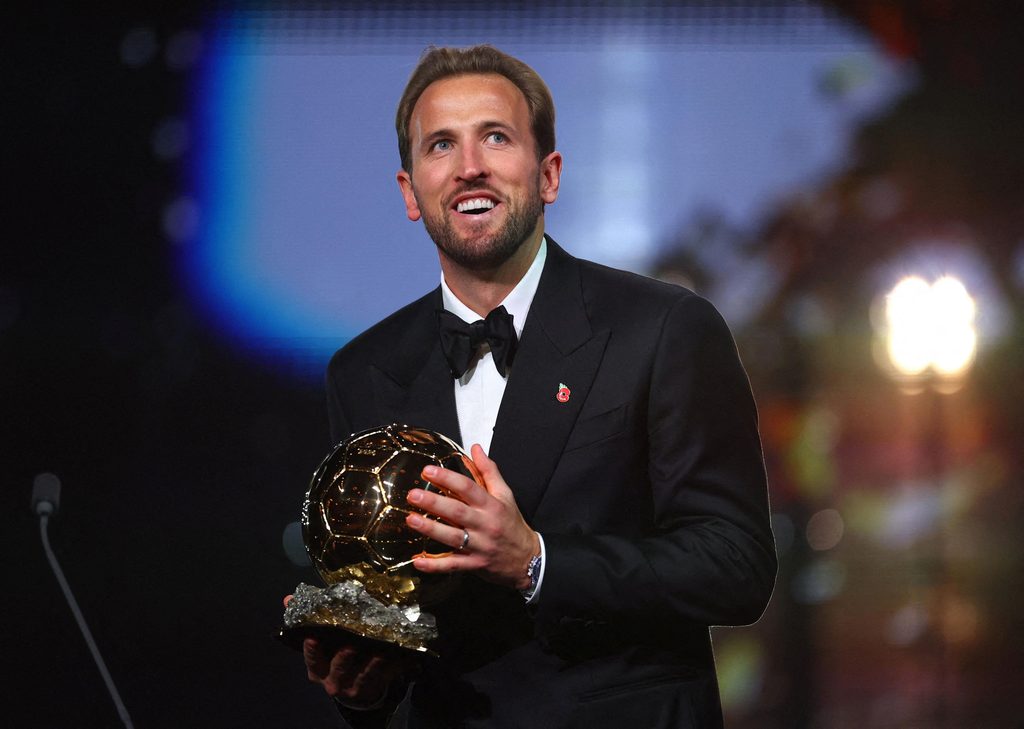
Last night, Harry Kane joined an exclusive club by winning the 2026 Ballon d’Or. The England captain became the seventh British player to receive the award, following in the footsteps of Stanley Matthews, Denis Law, Bobby Charlton, George Best, Kevin Keegan and Michael Owen. With eight Ballon d’Or awards shared between these seven players, thanks in particular to Keegan’s back-to-back victories in 1978 and 1979, the United Kingdom has a rich history with football’s most prestigious individual prize. Here is a look back at the winners who have shaped that history, from 1956 to 2026.
The seven British players to have won the Ballon d’Or
Stanley Matthews, the first-ever winner in 1956
On 18 December 1956, Stanley Matthews became the first winner of the Ballon d’Or, then known as the award for Europe’s Footballer of the Year. The Blackpool winger finished ahead of Alfredo Di Stéfano, the Real Madrid star, and Raymond Kopa. At 41, he also set a record for longevity that still stands: no player has won the award at a more advanced age, and it is unlikely that anyone will ever match his achievement. The award recognised an exceptional career and a 1955–56 season in which Matthews helped Blackpool finish second in the English First Division. Renowned for his dribbling, creativity and ability to beat defenders, he claimed the prize three years after Blackpool’s famous 4–3 victory over Bolton in the 1953 FA Cup final, a match that became known as the “Matthews Final”.
The voting was particularly close: Matthews collected 47 points, compared with 44 for Di Stéfano, while Kopa finished third with 33. Sixteen journalists from different European countries took part in this inaugural edition, organised by France Football. At the time, only European players were eligible, meaning Brazilian greats Pelé and Garrincha were among those excluded.
Denis Law, Scotland’s triumph in 1964
Eight years after Matthews, Denis Law became the first and only Scottish international player to win the Ballon d’Or in 1964. The Manchester United forward finished ahead of Spain’s Luis Suárez and Italy’s Amancio. The award recognised his finishing ability and his importance to United’s attacking play.
The 1963–64 season provided Law with his strongest case. He scored 30 league goals to finish as the English First Division’s leading scorer, and netted 46 times in all competitions for Manchester United. The Ballon d’Or therefore rewarded a year in which he established himself as one of the most prolific forwards in European football. His victory was also a significant milestone for Scottish football, whose other great names, including Kenny Dalglish, would later come close to winning the award without ultimately claiming it.
Bobby Charlton, a historic year in 1966
In 1966, Bobby Charlton added his name to the roll of honour after an outstanding year with Manchester United and England. The attacking midfielder played a central role in the Three Lions’ World Cup triumph on home soil. He scored three goals during the tournament, including a brace in the 2–1 semi-final victory over Portugal, led by Eusébio.
England then beat West Germany 4–2 after extra time in the final. Charlton finished ahead of Eusébio in the Ballon d’Or voting, with Franz Beckenbauer in third place. His victory underlined the decisive influence the World Cup could have on the voting at the time, as well as his standing as a leading figure in English football. A survivor of the 1958 Munich air disaster, Charlton embodied Manchester United’s revival alongside Denis Law and helped the club win the European Cup in 1968.
George Best, Northern Ireland’s genius in 1968
Two years later, during a decade that proved particularly successful for British football, George Best brought another Ballon d’Or to the United Kingdom. The Northern Irish Manchester United winger received the award in 1968, the year his club won the European Cup against Benfica. Best scored in the final as United secured a 4–1 victory after extra time, confirming his influence in a side that also featured Bobby Charlton and Denis Law.
With his dribbling, acceleration and technical ability, Best became one of the most recognisable players of his generation. He finished ahead of Bobby Charlton and Italy’s Gianni Rivera in the Ballon d’Or rankings, with the podium highlighting Manchester United’s dominance on the European stage in the late 1960s.
Kevin Keegan, back-to-back Ballon d’Or wins in 1978 and 1979
Kevin Keegan remains the only Englishman to have won the Ballon d’Or twice, and he did so in consecutive years. His first triumph, in 1978, was one of the most remarkable surprises in the award’s history. England had failed to qualify for the World Cup in Argentina, meaning the forward missed the tournament altogether. That was a significant disadvantage, as winning the Ballon d’Or in a World Cup year without having played in the finals was traditionally considered extremely difficult. What made the result even more surprising was that Keegan appeared to have an even stronger case a year earlier, having won the English league title and the European Cup with Liverpool. Yet he finished second in the 1977 vote, just three points behind Denmark’s Allan Simonsen.
After moving to Hamburg in the summer of 1977, Keegan also endured a difficult start in Germany, facing tensions with some team-mates and an eight-match suspension following an incident during a friendly. The arrival of Günter Netzer as sporting director in February 1978 changed everything. Repositioned at the heart of the team’s play, the Englishman became an essential figure for HSV, even though the club finished only tenth in the league. His performances for club and country eventually convinced the voters. On 20 September, he starred in a thrilling 4–3 England victory over Denmark, scoring twice and outshining Allan Simonsen, the reigning Ballon d’Or holder. In December, Keegan claimed the award with 87 points, six more than Austria’s Hans Krankl, who had enjoyed an excellent season and played at the World Cup. He thus became the first—and remains the only—player to win the Ballon d’Or without having featured at the World Cup in a year when the tournament was held.
That award foreshadowed an even more successful season. Under Branko Zebec, Hamburg won the German league title in 1979. Playing a more complete role behind the main striker, Keegan scored 17 Bundesliga goals, including 11 in the final 12 rounds of matches. He retained his Ballon d’Or with a much more convincing margin, finishing comfortably ahead of Karl-Heinz Rummenigge. The historic double recognised both his influence on the pitch and his ability to establish himself in a foreign league at a time when English players rarely moved to the continent.
Michael Owen, the last English winner before Kane in 2001
It took more than 20 years, until 2001, for another Englishman to lift the Ballon d’Or. Michael Owen, then a Liverpool forward, received the award after an exceptional season in which his club won five trophies, including the FA Cup, League Cup and UEFA Cup.
Owen scored twice in the closing minutes of the FA Cup final against Arsenal, turning the game around to give Liverpool a 2–1 victory. At international level, he also made headlines with a hat-trick in England’s 5–1 win over Germany in a World Cup qualifier. He finished ahead of Raúl and Oliver Kahn in the final standings. At just 22, he became the first Liverpool player to win the Ballon d’Or and the second-youngest winner in history, behind Ronaldo, who was 21 years and 92 days old in 1997. He was also the last Englishman to win the award before 2026.
Harry Kane, an exceptional season rewarded in 2026
Twenty-five years after Owen, Harry Kane ended the long wait by winning the 2026 Ballon d’Or, presented on 26 October in his home city of London. The England captain finished ahead of Kylian Mbappé and Lamine Yamal after a particularly prolific season with Bayern Munich and the national team.
Kane scored 73 goals in 65 appearances during the period under consideration, including 61 for Bayern and 12 for England. In Germany, he netted 36 Bundesliga goals and helped Bayern secure success in the league and the German Cup. For the Three Lions, he scored six times at the 2026 World Cup, which England finished in third place, while also reaching the Champions League semi-finals with Bayern. Beyond his finishing, his hold-up play, passing ability and contribution to build-up play make him a complete forward.
The award also recognises a career built on patience and hard work. After several loan spells early in his career and a prolific decade at Tottenham, Kane chose to join Bayern in 2023 to take the next step in his pursuit of team honours. His first Ballon d’Or earns him a place in the history of British football and ends a 25-year wait for England.