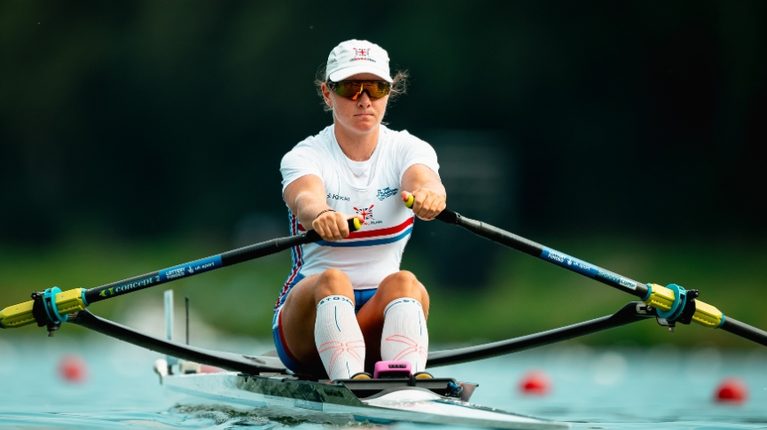
At just 24 years of age, Lauren Henry has already established herself as one of the leading figures in British rowing. Having claimed Olympic gold in the women’s quadruple sculls at Paris 2024, the Leicestershire rower has chosen to step away from the crew boat that took her to the top of the sport in pursuit of an even greater challenge: succeeding in the single sculls, rowing’s ultimate individual event. It is a bold decision, but one that already appears to be paying dividends, with her remarkable start suggesting she could be on course to make British rowing history.
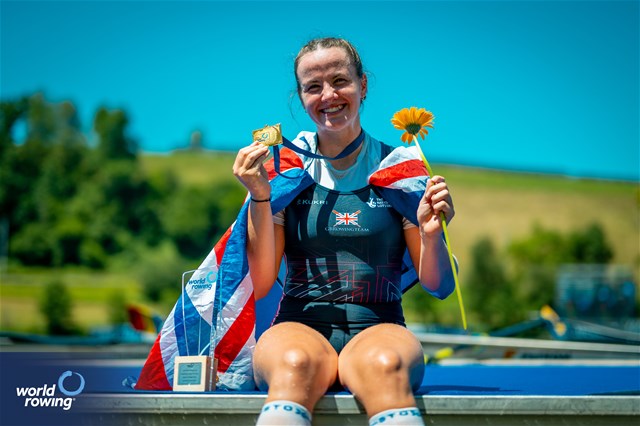
Lauren Henry: from Olympic glory to a new individual challenge
On 31 July 2024, Lauren Henry secured her place in British rowing history. Alongside Hannah Scott, Lola Anderson and Georgina Brayshaw, she claimed Olympic gold in the women’s quadruple sculls after one of the most memorable races of the Paris Games. For much of the final, it looked as though the Dutch crew had everything under control. They established an early lead and maintained their advantage deep into the race, while the British quartet remained their closest challengers. But over the closing 200 metres, Henry and her crewmates produced an extraordinary sprint finish, reeling in the Netherlands before crossing the line first in 6:16.31, just 0.15 seconds ahead of their rivals. The victory delivered the United Kingdom’s first-ever Olympic title in the women’s quadruple sculls and capped a remarkable two-year spell for the crew, having already won the world title in 2023.
Rather than continuing with one of the world’s dominant boats, however, Henry opted for a dramatic change of direction by moving into the single sculls. At first glance, the decision appeared a surprising one. the UK has long been regarded as the benchmark nation in crew boats, collecting Olympic and World Championship titles in pairs, fours and eights over several decades. Those events have become synonymous with British success and are a major reason why rowing remains one of the country’s strongest Olympic sports.
The single sculls, however, tell a very different story. Since the women’s event was introduced at the Montreal Olympics in 1976, no British woman has ever won an Olympic medal in the single sculls. The men’s record offers little more encouragement. Alan Campbell claimed bronze on home waters at London 2012, ending an 84-year wait stretching back to David Collet’s bronze medal at the Amsterdam Olympics in 1928.
It is against this rather unforgiving historical backdrop that Lauren Henry is attempting to write a new chapter for British rowing. If her current trajectory continues, she could even arrive at the Marine Stadium for the Los Angeles 2028 Olympic Games as one of the favourites for gold. The early evidence certainly supports that belief. In her very first international season as a senior single sculler, Henry claimed the 2025 European title in Plovdiv while setting both a new British record and the fastest time ever recorded by a European athlete in the event, stopping the clock at 7:09.76. That performance also became the second-fastest time ever achieved in the history of the women’s single sculls, immediately establishing her among the sport’s elite.
The Olympic champion was far from finished. She went on to win both World Rowing Cup regattas she contested in 2025 before travelling to the World Rowing Championships in Shanghai with an openly stated ambition of becoming the first British woman ever to win a senior world title in the single sculls. History ultimately slipped through her fingers by the narrowest of margins as Henry was beaten by Fiona Murtagh by just three hundredths of a second after an enthralling race, having to settle for the silver medal. Yet rather than representing disappointment, the result confirmed that her European triumph had been no one-off. Within just a year of switching boats, she had firmly established herself among the very best single scullers in the world.
That agonising defeat has done little to slow her momentum. Henry began the 2026 international season in perfect fashion by winning the opening World Rowing Cup in Seville. Once again, it was her devastating finishing speed that proved decisive as she reeled in Lithuania’s Viktorija Senkute during the closing stages to snatch victory. A few weeks later in Lucerne, she again dominated proceedings, comfortably progressing through the heats before controlling the final with increasing authority. Despite another convincing victory, Henry insisted afterwards that she still believed she was some way from reaching her full potential.
Henry had already demonstrated her potential in the single sculls by winning the overall British Rowing Senior Trials in 2023 while she was still eligible to compete at Under-23 level. Even before her Olympic triumph, the foundations for a successful transition had already been laid. Her time in the quadruple sculls provided invaluable experience of performing under the greatest pressure, experience that culminated in Olympic gold before she returned to what increasingly appears to be her natural discipline. Henry herself has spoken about enjoying the complete control that comes with racing the single, where every tactical decision and every stroke rests solely on her own shoulders.
At just 24, Lauren Henry appears to possess every attribute required to address one of the final gaps in Britain’s extraordinary rowing legacy. In a nation that has dominated crew boats for generations, she now has the opportunity to restore the United Kingdom to the summit of the sport’s most prestigious individual event. Judging by everything she has achieved since making the switch, that ambition no longer feels aspirational, it feels increasingly realistic.