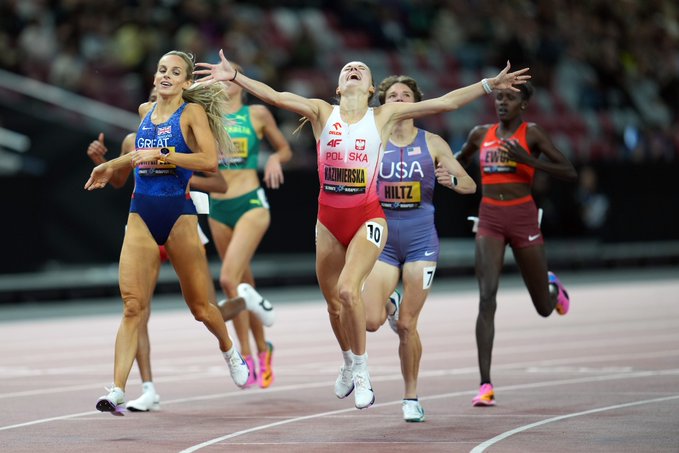
The British 4x100m relays completed a clean sweep in Birmingham by winning both European titles. Following the individual successes of Amy Hunt and Romell Glave over 100m, as well as silver medals for Azu over 100m and Zharnel Hughes over 200m, the United Kingdom continued its strong showing in the sprint events. The women retained their continental title, while the men reclaimed a crown they had last won in 2022. For Amy Hunt, the victory already represents her third gold medal of these European Championships.
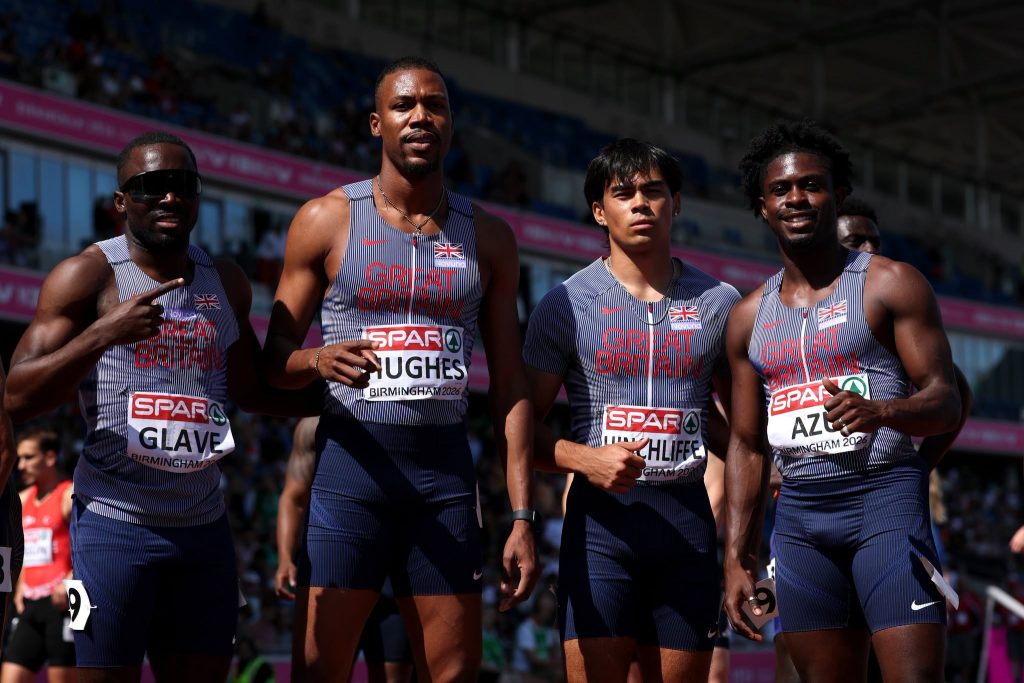
Two British relays, two European titles in Birmingham
The day had begun with the 4x100m heats, with the two British relays facing slightly different situations. In the women’s event, Kristal Ama-Awuah, Amy Hunt, Success Eduan and Imani Lansiquot finished second in their heat behind Italy in 42.23, but their time was still the second-fastest of all the finalists. The second heat was slower, leaving the British quartet with clear room for improvement ahead of the final.
There were also areas to address in the baton exchanges. The handovers had been solid enough, but they lacked some of the fluidity required to produce a truly fast relay time. The British quartet had also been drawn in lane three for the heats, which made it more difficult to assess its full potential against the field. Crucially, Kristal Ama-Awuah was replaced by Dina Asher-Smith for the final. The change brought both greater experience at major championships and additional speed on the opening leg. The remainder of the team remained unchanged, with Hunt running second, Eduan third and Lansiquot anchoring the relay.
The men, meanwhile, were expected to retain the same line-up for the final. Azu, Louie Hinchliffe, Zharnel Hughes and Romell Glave had produced the fastest qualifying time in 38.29, comfortably ahead of the 38.50 recorded in the other heat. Their baton exchanges could still have been sharper, but the British quartet had enough in hand to avoid taking unnecessary risks over the closing stages.
Glave, in particular, had been able to control his effort down the final straight after seeing the advantage already established by the United Kingdom. The British team had nevertheless been forced to run from lane nine, a position which is not ideal for judging the race tactically from the outset. Having posted the fastest qualifying time, however, the quartet earned a considerably more favourable lane for the final.
The men’s relay opened the evening’s finals and this time lined up in lane six. The United Kingdom did not produce its fastest time of the competition, but Azu, Hinchliffe, Hughes and Glave still secured the European title in 38.45, ahead of Germany in 38.64, with Belgium taking third. The baton exchanges were not flawless, particularly between Hinchliffe and Hughes, but the individual quality of the four British sprinters ultimately proved decisive. Glave received the baton marginally in front, with the leading teams still closely bunched at that stage. The reigning European 100m champion then produced the decisive acceleration down the final straight, immediately opening a gap and allowing the United Kingdom to secure victory without being seriously threatened.
Minutes later, the women produced an even more polished performance. With Asher-Smith leading off, Hunt running second, Eduan third and Lansiquot anchoring, the United Kingdom delivered a highly efficient final. From lane seven, the four British sprinters executed the race with considerably greater precision than they had shown in the heats and stopped the clock at 42.05, despite the cool conditions around the Alexander Stadium.
Asher-Smith made an excellent start to the relay before handing over to Hunt. The British sprinter, already crowned European champion over both 100m and 200m in Birmingham, immediately made full use of her speed on the second leg. The United Kingdom began to extend its advantage through the back straight and was never genuinely threatened thereafter. Eduan and Lansiquot continued the work with clean exchanges, allowing the British quartet to maintain a substantial lead through the closing stages. The United Kingdom eventually crossed the line in 42.05, more than a second clear of Switzerland, who finished second in 43.12, with Poland taking bronze in 43.15.
The performance was particularly significant because it represented the fastest European time of the year. The previous leading mark had also belonged to the United Kingdom, with this same quartet of Asher-Smith, Hunt, Eduan and Lansiquot having clocked 42.06 at the London Diamond League on 18 July. They therefore lowered their own European-leading mark by one hundredth of a second when it mattered most. For Hunt, the victory represents her third gold medal in three events in Birmingham. After securing the individual European titles over 100m and 200m, the British sprinter now has the opportunity to complete an extraordinary four-title haul. She is expected to feature for the United Kingdom in the mixed 4x100m relay, scheduled for tomorrow.
The men’s victory also restores the United Kingdom to the top of the European podium after missing out on the title in 2024. The British quartet had previously won four consecutive European titles in 2014, 2016, 2018 and 2022, before being denied another victory in 2024. The women, meanwhile, successfully defended their European crown following their triumph in 2024, having also won the event in 2014 and 2018.