Kimani Jack reached a major milestone this weekend by clearing 2.31m at a meeting in Athens, Georgia. A performance that propels him among the global elite at just 22 years of age, and one that confirms the emergence of a raw talent in British athletics.
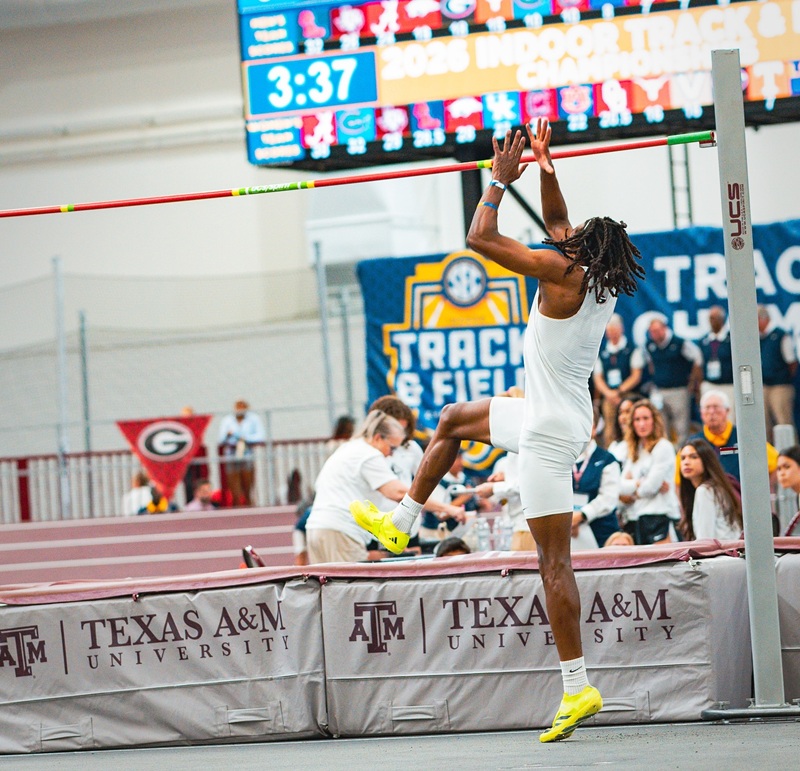
Kimani Jack, the rise of a raw talent at the top of the NCAA
The breakthrough had been anticipated; it is now a reality. By clearing 2.31m, Kimani Jack not only set a new personal best, but also ended a six-year drought for British high jump. No athlete from the United Kingdom had gone beyond 2.30m since 2020, and the University of Georgia athlete now stands as the joint seventh-best British performer of all time.
This near-perfect competition, in which he cleared every height at the first attempt up to 2.31m, highlights an impressive level of technical control. After a first miss at that height, Jack responded immediately, going over on his second attempt with relatively comfortable clearance.
This performance is part of a remarkably consistent upward trajectory. Since opening at 2.02m in 2021, Jack has steadily progressed: 2.10m in 2023, 2.15m in 2024, and then 2.21m in 2025 during his first experiences at senior level. However, it is in 2026 that everything has accelerated. Within a matter of months on the NCAA circuit, he has put together a sequence of high-level performances: 2.25m as early as January, 2.28m in February to claim the SEC indoor title, followed by 2.24m in April, before this leap to 2.31m in early May.
The decision to move to the United States and compete within the NCAA system has proven decisive. In an ultra-competitive environment, one increasingly favoured by young British athletes, Jack has found the ideal conditions to elevate his level. Now holding both the indoor and outdoor records for his university, he has also established himself as the leading British high jumper and the third-best performer in the world this season, albeit at a very early stage of the year. By comparison, a mark of 2.31m would have ranked him seventh globally in 2025.
This jump places him alongside several historic names in British high jump at 2.31m, just behind Tom Gale’s 2.33m from 2020. At only 22, there remains significant room for progression.
Other British results of the week
Behind Kimani Jack’s standout performance, several other British athletes made their mark, particularly on American soil.
After several seasons of coming close to the barrier, Daniel Falode has finally surpassed 16 metres in the triple jump. With a leap measured at 16.07m, achieved despite a challenging headwind (-1.2 m/s), the 23-year-old validates long-expected progress, with his previous best dating back to 2020. This mark not only represents a personal best but also stands as the British lead for the season, 6cm ahead of the highly promising Tito Odunaike, who only turned 17 yesterday and recorded 16.01m on 7 February.
Over the 400m hurdles, Rayhan Mourtada made an immediate impression. In just his third outing of the season, he clocked a personal best of 51.27 seconds, improving an already strong mark. This performance places him among the top NCAA freshmen this year and underlines his potential in an event that has seen clear progression in the United Kingdom in recent years.
A similar trend can be seen in the flat 400m, where 19-year-old Emma Holmes produced a significant breakthrough. Clocking 52.92 seconds, she lowered her personal best by more than half a second. It is a substantial improvement that fits into a clearly upward curve, having been above the 55-second mark not long ago.
In the short sprints, Jake Odey Jordan continues his breakthrough season. His time of 10.17 seconds over 100m leaves him just one hundredth shy of his recently set personal best. However, beyond the raw time, the context is particularly notable: a wind reading of +1.0 m/s, well within legal limits, unlike his current personal best which was recorded with a +2.0 m/s wind.
Finally, the most unexpected moment of the week undoubtedly came with the return of Jake Heyward. The British 1500m European silver medallist from 2022 had not competed for nearly four years. At 27, he marked his comeback with victory in California, posting a solid 3:37.75. While still some way off his personal best, the performance primarily signals a promising return to competition after a prolonged absence.