An outstanding spring campaign in 2026 has propelled 17-year-old Havering AC athlete Freddie Rowe firmly into the spotlight. The young middle-distance prospect has produced a string of high-class performances over both the 1500m and the mile, breaking the British U18 mile record, comfortably securing the qualifying standard for the European U18 Championships and drawing comparisons with some of the greatest names in British middle-distance history. His emergence is part of a long-standing tradition of excellence that has established the United Kingdom as one of the world’s leading middle-distance nations for decades.
A meteoric rise placing him among the world’s best young athletes
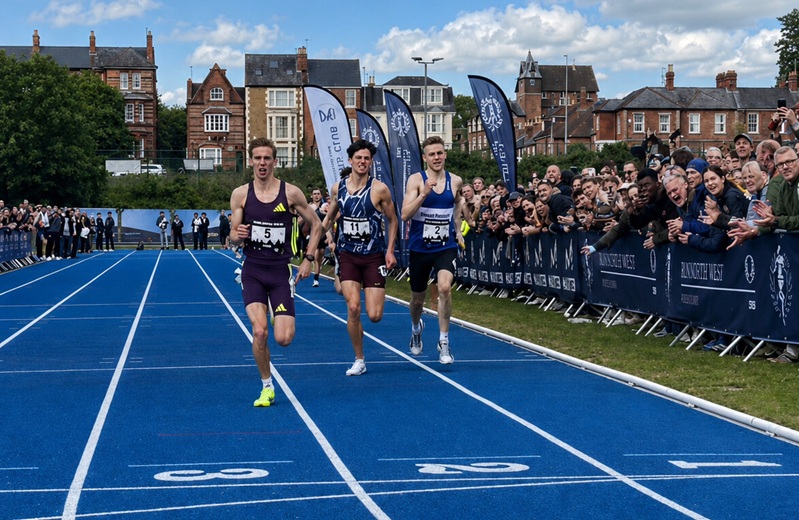
Freddie Rowe’s 2026 season is not yet over, but it has already been an overwhelming success. His breakthrough spring began in April with victory in the boys’ U18 race at the Mini London Marathon. A few weeks later, the young Brit delivered another statement performance in Oxford, winning the Bannister Miles in 4:00.88 to set a new British U18 mile record.
On May 13, at the BMC Gold Standard Races in Birmingham, Rowe claimed victory over 1500m in 3:45.78. The performance placed him more than four seconds inside the qualifying standard for the European U18 Championships, which will take place in Rieti, Italy, from July 16 to 19.
At that point, many athletes would already have considered their primary objective achieved ahead of the summer championships. Rowe, however, was only getting started. On May 30, at the British Milers Club Grand Prix in Birmingham, he produced what currently stands as the finest performance of his young career. Competing in a particularly strong field, the teenager finished third in the men’s A race and stopped the clock at an outstanding 3:40.26.
In the space of just over two weeks, he slashed more than five seconds from his personal best. Looking at the bigger picture, his progression over the last three seasons has been remarkable, even by the standards of developing junior athletes. In 2024, he was running 4:01.13 for 1500m. By 2025, he had made a huge leap to 3:44.62. Now, in 2026, he has lowered that mark to 3:40.26, taking almost 21 seconds off his best time in just over two years.
The performance makes him the second-fastest British 17-year-old in history over 1500m. The only athlete ahead of him is Steve Cram, who ran 3:40.09 back in 1978. Cram would go on to become world champion over 1500m in 1983, Olympic silver medallist in 1984 and world record holder over the 1500m, 2000m and the mile during the mid-1980s.
Of course, it is far too early to predict a similar career trajectory for Rowe. However, whenever a teenager finds himself being compared statistically with one of Britain’s greatest-ever middle-distance runners, it is difficult not to view it as an extremely encouraging sign.
His standing on the international stage is equally impressive. Rowe’s 3:40.26 currently ranks him ninth in the world among U20 athletes in 2026. That statistic becomes even more significant when viewed in context. Most of the athletes ahead of him are either 18 or 19 years old, while Rowe is still only 17. The only athlete of a similar age among the world’s elite is New Zealand phenomenon Sam Ruthe, born in 2009.
At European U18 level, Rowe’s performance places him at the very top of the continental rankings. Prior to his Birmingham breakthrough, the fastest European U18 time of the year belonged to Spain’s Alex Sangil with 3:44.89. With his 3:40.26, Rowe can now realistically head to Rieti as one of the leading contenders for European gold.
Beyond the raw times, his racing intelligence is already beginning to stand out. Whether it was his tactically astute victory in the Gandy Mile at Loughborough or his performances in Birmingham, Rowe has demonstrated an ability to adapt to different race scenarios and varying tactical demands. In modern championship racing, where medals are often decided by positioning, patience and decision-making rather than outright pace, that quality has become invaluable. The fact that the last nine major global 1500m titles have been won by nine different athletes illustrates just how important tactical versatility has become.
Following a tradition that has made the UK a middle-distance powerhouse
Freddie Rowe’s emergence comes at a particularly favourable time. Few nations can boast a middle-distance pedigree as rich as that of the United Kingdom.
The 1980s rivalry between Steve Cram, Sebastian Coe and Steve Ovett remains one of the defining eras in the history of athletics. The trio dominated major international championships and repeatedly broke world records, establishing Britain as the benchmark nation over both 800m and 1500m.
That tradition has never truly disappeared. Subsequent generations have continued to uphold the country’s reputation. Kelly Holmes famously completed an historic 800m and 1500m double at the Athens Olympics in 2004, further reinforcing Britain’s status as a middle-distance stronghold.
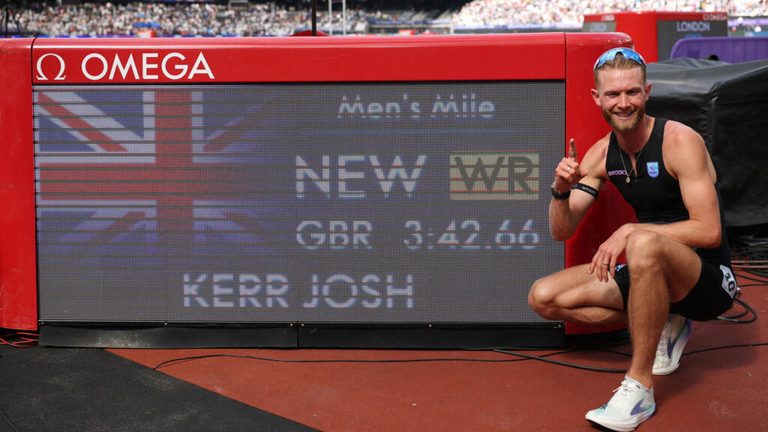
Today, British middle-distance running appears to be enjoying another golden era. On the men’s side, Josh Kerr became world champion over 1500m in 2023 after Jake Wightman’s world title triumph in 2022. Among the women, Keely Hodgkinson has established herself as one of the world’s premier 800m runners, while Laura Muir and Georgia Hunter Bell have accumulated major international medals in recent years.
Wightman himself recently summed up the situation by describing the United Kingdom as “the best middle-distance nation in the world”.
The depth of talent is equally apparent at junior level. Across the last two editions of the European U18 and U20 Championships, British athletes have collected a host of medals and titles over 800m and 1500m. Athletes such as Matthew McKenna, Lyla Belshaw, Annie Mann, Iris Downes, Rafferty Mirfin and Tom Waterworth have all played their part in strengthening this impressive production line of talent.
Belshaw has already claimed both European U18 and European U20 1500m titles, while McKenna appeared destined to follow a similar path over 800m before being disqualified at the 2025 European U20 Championships after stepping off the track during an incident in the closing stages of the race. Both athletes highlight Britain’s ability to develop young prospects and guide them towards the highest level, with many eventually progressing to major senior championships and the Olympic Games.
The European U18 Championships will naturally be Rowe’s primary target this summer. However, based on his current level, his ambitions may soon extend beyond the continental stage. At just 17 years of age, he already possesses the ability to compete with the world’s best U20 athletes and, while Sam Ruthe appears to be operating on another level altogether, a medal at the World U20 Championships later this year is certainly not beyond reach if he chooses to go.