Divine Iheme, Savannah Morgan-McKenzie, Mathew Ajayi and Sophie Thomas stole the headlines by setting a new World U20 record in the mixed 4x100m relay on the second day of the World Athletics U20 Championships in Eugene. It proved to be another productive day for the British team, with several athletes progressing through the rounds, Thea Brown narrowly missing out on a heptathlon medal, and Jake Odey-Jordan finishing fifth in the men’s 100m final.
World record sets up wide-open relay final
The standout British performance came in the mixed 4x100m relay, making its global debut at the World U20 Championships. The morning session had already produced history, with Australia setting the first-ever World U20 record at 41.64 in the opening heat. Even then, it felt unlikely that the mark would survive for long given the quality of the teams still to race.
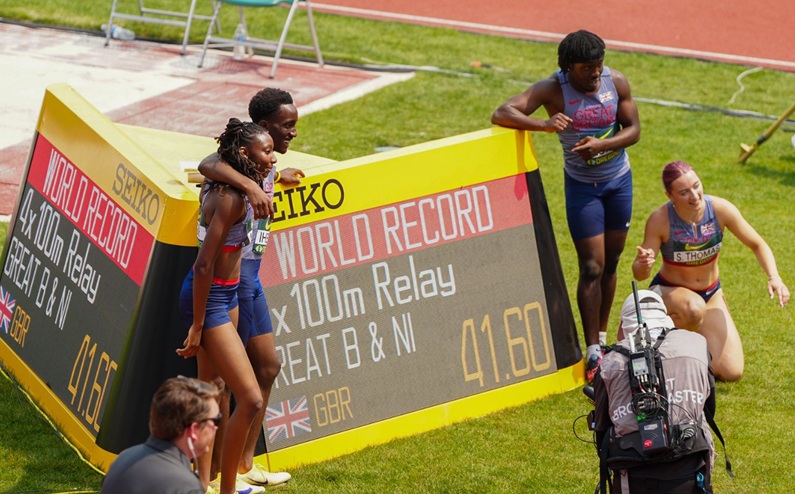
That prediction proved correct only minutes later. the british quartet of Divine Iheme, Savannah Morgan-McKenzie, Mathew Ajayi and Sophie Thomas delivered an outstanding performance to win the second heat in 41.60, lowering the newly-established world record by four hundredths of a second.
The British success was built on clean baton exchanges throughout the race. Ajayi produced a superb bend leg to extend Britain’s momentum before handing over to Thomas, who controlled the anchor leg impressively and increased the advantage she had already inherited. The result not only secured victory in the heat but also rewrote the World U20 record books.
The United States won the third and final heat in 41.82, while Italy (41.74), Nigeria (41.91) and Jamaica (42.08) also booked their places in what promises to be an exceptionally competitive final. The United Kingdom head into Saturday’s showdown as the fastest qualifiers, although the question now is whether the selectors will retain the same quartet after such a polished performance or opt to introduce fresh legs. With margins between the leading nations measured in tenths of a second, relay chemistry could prove just as important as outright speed.
Away from the relay, Rayhan Mourtada continued his impressive progress in the men’s 400m hurdles. The Blackheath athlete booked his place in the semi-finals with a personal best of 50.68, taking two tenths off his previous best and moving up to eighth on the British all-time U20 rankings ahead of the next round.
The UK will also be represented in both 1500m finals. James Alexander qualified in convincing fashion, posting 3:42.55, the second-fastest time across all the heats. Lyla Belshaw also progressed after finishing fourth in her heat in 4:20.19, comfortably securing her place in the final.
In the women’s 400m, Casey Musgrave successfully negotiated two rounds in the space of a few hours. After finishing second in her morning heat, she returned later in the day to place third in her semi-final and secure a deserved place in the championship final. British athletes also enjoyed success in the men’s high jump, where both Samuel James, the newly crowned European U18 champion, and Otis Poole progressed to the final after clearing 2.14m.
There was, however, some disappointment elsewhere. Jake Odey-Jordan finished fifth in the men’s 100m final in 10.31. Arriving in Eugene as the second-fastest athlete in the field this season thanks to his outstanding 10.01 personal best, the British sprinter never quite rediscovered the form he displayed earlier in the year. During the spring he clocked times of 9.98, 10.01 and 10.09, establishing himself as one of the world’s leading U20 sprinters. Since July, however, his performances have consistently been around the 10.30 mark, a trend that ultimately continued throughout these championships.
The biggest frustration from a British perspective came in the women’s heptathlon. Having occupied a medal position for virtually the entire competition, Thea Brown eventually finished fourth with 5,826 points, a new personal best and the fifth-highest score ever achieved by a British U20 athlete.
Brown produced personal bests in the 100m hurdles, shot put and javelin, improving with every throw in the javelin to reach 35.46m, despite competing with heavy strapping on her thigh. She started the concluding 800m holding almost a 200-point advantage over the athlete in fourth place and appeared well placed to secure a medal. However, clearly hampered by injury, she could only manage 2:34.10—almost ten seconds slower than her season’s best—which ultimately proved decisive. Brown missed out on the podium by only a handful of points, a cruel conclusion to an otherwise outstanding championship that nevertheless demonstrated her continued development at international level.
Elsewhere, Daisy Snell rounded off her championships with an encouraging sixth-place finish in the women’s long jump final. Her best leap of 6.22m represented another consistent performance on the international stage and built on the progress she has made since finishing ninth at last year’s European U20 Championships.