Zoe Bäckstedt claimed the silver medal in the time trial at the 2026 Cycling World Championships in Montreal, on her first appearance at senior level. At just 21, the British rider put Marlen Reusser under pressure for much of the race, before the Swiss rider eventually took control in the second half of the 39.2-kilometre course. The defending world champion retained her rainbow jersey with a 40-second advantage, but Bäckstedt, competing at her first senior World Championships, confirmed that she already belongs among the very best time triallists in the world.
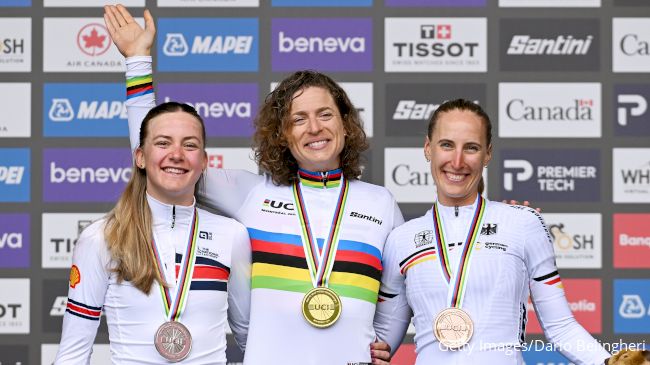
Zoe Bäckstedt finishes runner-up to a Marlen Reusser who remains one step ahead
There was a certain inevitability to Marlen Reusser starting as the overwhelming favourite in Montreal. The 35-year-old Swiss rider arrived as the defending world champion after her victory in Kigali in 2025, but also with a level of dominance that now extends beyond her world title record alone. For several years, she has established herself as the benchmark in women’s time trialling, capable of sustaining exceptional power over long, fast sections of road. Like Remco Evenepoel in the men’s event, Reusser has become the rider to beat whenever a course favours the individual effort against the clock.
Bäckstedt, however, had no intention of simply getting a taste of senior-level competition. The British rider had chosen to give up the chance to defend her world title at under-23 level in order to go head-to-head with the best riders in the field. It was a decision that carried an element of risk on a 39.2-kilometre course, a particularly demanding distance for a 21-year-old rider. Bäckstedt immediately took control of the race. At the first time check, she held an advantage of around ten seconds over Reusser. The British rider then retained the lead at the second split, to the point where the possibility of an upset was no longer merely theoretical. After just over half the course, Reusser had managed to cut the gap to only a few seconds.
The balance of power, however, was gradually beginning to shift. Reusser started to claw back time on the long sections where her ability to maintain a high pace made the difference. At the second time check, she was just three seconds behind Bäckstedt. Then, around the 29-kilometre mark, the Swiss rider had completely turned the race around: she was now 13 seconds ahead of the British rider. The final part of the race only confirmed that trend. Reusser continued to extend her advantage before crossing the line in 50:24.44, 40.11 seconds ahead of Bäckstedt. Franziska Koch completed the podium, 45.54 seconds behind the world champion. The British rider therefore finished ahead of several established names in the discipline, including Demi Vollering, who could only manage eighth place, almost 1:50 behind.
The result is all the more significant because Bäckstedt was not racing on a course designed exclusively around her strengths. She acknowledged this herself after the finish: the distance was longer than what she currently considers her comfort zone. The British rider still regards 25 to 30 kilometres as the distance at which she is at her best. Over almost 40 kilometres, pacing and energy management therefore became an essential part of the race.
She nevertheless held her own extremely well during the opening part of the course before paying the price, more than Reusser, for the length of the effort in the closing kilometres. The contrast between the two riders is ultimately revealing: at 35, Reusser has considerable experience in this type of effort and built her victory around the second half of the race. At 21, Bäckstedt already has the speed required to take several seconds out of the benchmark rider in the discipline, but still needs to improve her ability to sustain that level all the way to the finish.
At 21, she is already a world champion at junior and under-23 level and is now second among the seniors, with almost two more years to develop before the 2028 Olympic Games in Los Angeles. Reusser will be 37 by then. This age difference obviously guarantees no change in the hierarchy, but it is an important factor when considering how the two riders may develop. Bäckstedt can still develop her power, endurance and, above all, her experience over longer distances, while Reusser will have to maintain the level that currently allows her to dominate her rivals.