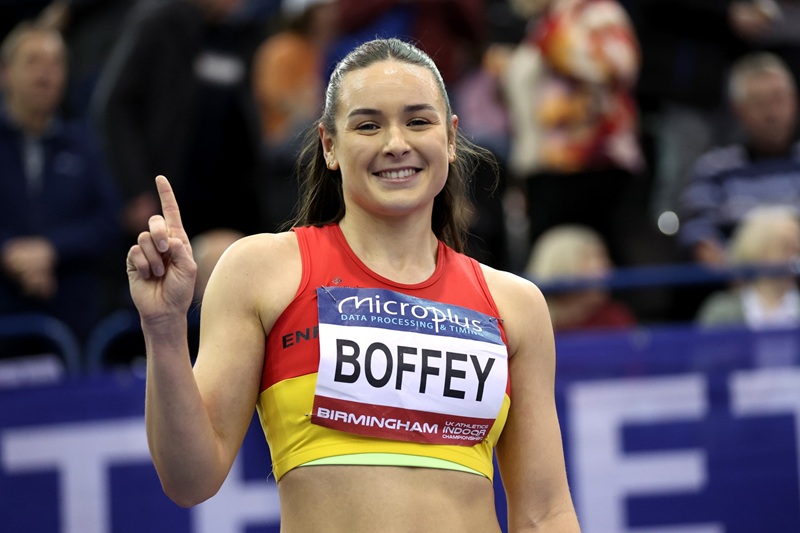
For years, Isabelle Boffey had been regarded as one of the brightest prospects in British athletics, a prodigy who collected junior titles with remarkable regularity. In Boston, she may finally have reached the defining moment of her career. At 25 years old, the Enfield-based middle-distance runner produced a truly outstanding performance, storming to an 800 metres victory in 1:57.43 — obliterating her personal best and immediately elevating herself to second place on the British indoor all-time list, behind only the seemingly untouchable Keely Hodgkinson.
Junior dominance followed by a longer road to senior confirmation
The name Isabelle Boffey is far from unfamiliar to those who closely follow British athletics. A product of the Enfield & Haringey Athletics Club, she asserted her authority over her generation from an early age, achieving a feat few European athletes can claim: a clean sweep of gold medals in the 800 metres across all three European age-group championships. Gold in Tbilisi at the European U18 Championships in 2016, gold again in Borås at U20 level in 2019, and a third continental title at the U23 Championships in Tallinn in 2021 — Boffey was relentlessly consistent, establishing herself as a reference point in European junior middle-distance running.
Her progression on the clock during her teenage years underlined that promise. From 2:14 at the age of 14, she cut her time year after year, reaching 2:02.92 by the age of 19 while claiming European U20 gold. Everything appeared to be aligning for a smooth transition into the senior ranks.
That transition, however, proved more complex. While Boffey quickly gained exposure to major championships — finishing sixth at the European Indoor Championships in 2021, securing a maiden British indoor title in 2023, and representing Great Britain at the World Championships in Budapest later that year — her times plateaued. Between 2020 and 2023, the improvements were marginal. Tenths were shaved rather than seconds, before she finally broke the symbolic two-minute barrier outdoors with a 1:59.30 in Madrid in the summer of 2023.
It was a significant milestone, but not one that immediately propelled her into the global elite. In a British system rich in middle-distance talent, Boffey appeared stuck in a competitive limbo — good enough to qualify, not yet fast enough to dominate.
The following seasons only reinforced that sense of frustration. A serious hamstring injury in 2024 sidelined her for much of the year, interrupting continuity and momentum. Upon her return, she struggled to find the incremental gains required to move forward. The 2024 and 2025 seasons ended with performances below her lifetime best, fuelling the perception of an athlete whose early brilliance had yet to fully translate at senior level.
Then came 30 January 2026. At the prestigious John Thomas Terrier Classic in Boston, Isabelle Boffey did far more than win a race — she transformed her standing within British athletics. In a high-quality field and a race driven at record pace, the Briton never looked under pressure. Slightly behind Keely Hodgkinson’s British-record splits at the 200-metre mark, Boffey gradually asserted herself as the race unfolded. What followed was a finish of exceptional authority: a final lap covered in 29.54 seconds, showcasing both strength and composure.
The final time of 1:57.43 tells a remarkable story. Nearly two seconds faster than her previous personal best, it marked her first-ever sub-two-minute performance indoors. More importantly, it placed her second on the British indoor all-time list, eighth on the global indoor all-time rankings, and firmly in contention as the next national benchmark behind Hodgkinson in an event that remains fiercely competitive in the UK.
The significance of the run becomes even clearer when viewed in context. Since 2019, Boffey had not experienced a genuine breakthrough in performance terms. Her progression appeared linear, almost static, with best times hovering around the low 2:01s before dipping marginally under 1:59 outdoors. Boston changed that narrative in one decisive stroke.
Equally striking was the manner of the performance. Where many 800m runners rely on a devastating final kick, Boffey demonstrated an exceptional ability to sustain speed over the final 600 metres. When her splits are compared directly to Hodgkinson’s British record run, Boffey is actually faster over the final three 200m segments.
Behind Keely Hodgkinson, the undisputed leader of British women’s middle-distance running, several athletes have been vying for prominence, including Georgia Hunter Bell and the prodigiously talented Phoebe Gill. Isabelle Boffey has now firmly entered that conversation. The next challenge is clear: translating this indoor explosion to the outdoor circuit. If she can do so, she may finally secure her place among the world’s very best — not as a former prodigy, but as a fully realised elite athlete.