The second day of the 2026 European Track Cycling Championships confirmed the United Kingdom’s growing momentum in Konya. Led by Joe Truman, finally crowned European champion in the kilometre time trial, and by a dominant women’s team pursuit squad that claimed gold with a new world record, the British team enjoyed a night of performances at the very highest level. Emma Finucane and Sophie Capewell also secured their places in the sprint semi-finals, while youngsters Ben Wiggins and Henry Hobbs continued to gain valuable experience against Europe’s elite.
How the day unfolded
Day two began with the women’s individual sprint qualifying, where the pecking order quickly became clear. Emma Finucane produced a stunning ride to stop the clock at 9.759 seconds, setting a new world record and putting significant daylight between herself and the rest of the field. Behind her, Sophie Capewell reinforced Great Britain’s dominance by posting 9.982, making the British pair the only riders to dip under the ten-second barrier. Germany’s Lea Sophie Friedrich, neutral athlete Alina Lysenko, and Pauline Grabosch completed the group of main contenders, but already found themselves at a notable disadvantage compared to the two British riders.
The knockout phase got underway in the evening with the quarter-finals, and once again Finucane and Capewell delivered with authority. Up against Yana Burlakova, Finucane controlled both heats with ease, never allowing the Russian rider to mount a serious challenge. Capewell followed an identical script against Italy’s Miriam Vece, wrapping up her match in two straight rides. Those wins confirmed an all-important double British presence in the semi-finals, scheduled for the following day, alongside Friedrich and Lysenko. The latter two emerged from far more demanding match-ups, notably Friedrich’s victory over reigning world champion Hetty van de Wouw.
Running alongside the women’s sprint, the men’s points race was one of the key events of the day for Great Britain, with Ben Wiggins lining up for his senior European Championship debut. From the early stages, the British rider showed intent, opening his account at the third sprint before positioning himself in a decisive move. Riding alongside Benjamin Thomas and Dane Conrad Haugsted, Wiggins successfully gained a lap on the main bunch, banking twenty points and briefly moving into a virtual podium position.
Despite the constantly shifting standings typical of the discipline, Wiggins remained firmly in contention, picking up points consistently and even claiming victory in the tenth sprint. His solo attempt to take an additional lap proved particularly eye-catching, momentarily putting him at the top of the virtual classification—an outstanding effort given the calibre of specialists in the field. Inevitably, the physical cost of that move told in the closing stages, and Wiggins eventually finished fourth, just off the podium, in a race won by Germany’s Tim Torn Teutenberg. While the result does not come with a medal, it was a highly encouraging performance from the 20-year-old in his first appearance at this level.
The evening then shifted focus to the men’s kilometre time trial, which delivered one of Great Britain’s standout moments of the championships so far. With 25 riders contesting the qualifiers and only the top eight advancing to the final, margins were tight. Joe Truman negotiated the morning session expertly, qualifying third in 57.996, putting himself in a strong position for the final, which was ridden in reverse qualifying order.
In the final, Truman raised his level significantly. Sharper from the gate and more controlled through the second half of the effort, he stopped the clock at 57.541, slicing nearly half a second off his qualifying time. That performance secured him the European title, ahead of France’s Étienne Oliviero and Czech rider David Peterka. It was a particularly meaningful victory for Truman, who has accumulated numerous European and world medals over the years but had never previously stood on the top step at continental level.
The highlight of the evening, however, came in the women’s team pursuit. After a solid qualifying time of 4:07.447, British coaches made a decisive call, bringing Katie Archibald into the line-up for the first round in place of Kate Richardson. The impact was immediate. Alongside Josie Knight, Anna Morris, and Millie Couzens, the British quartet stormed to a 4:03.634, smashing the world record and booking their place in the final against Germany.
The gold-medal ride followed a similar pattern. Always ahead at the intermediate checks, Great Britain once again lowered the world benchmark, delivering a controlled and commanding performance to claim European gold, a title that had eluded them since 2023.
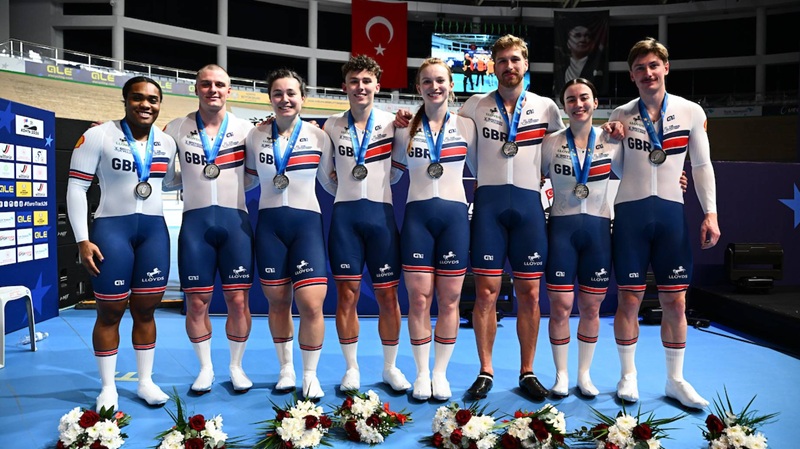
The day concluded with the men’s team pursuit. Second fastest in qualifying with a time of 3:46.497, the British quartet—featuring debutants Henry Hobbs and Ben Wiggins, improved their performance in the first round but narrowly missed out on the gold-medal final. Relegated to the bronze-medal race against France, the line-up was adjusted, with William Tidball brought in to replace a visibly fatigued Wiggins after his demanding points race earlier in the evening. The change proved effective, as Great Britain controlled the ride and secured the bronze medal, rounding off a thoroughly successful second day for the British team in Konya.