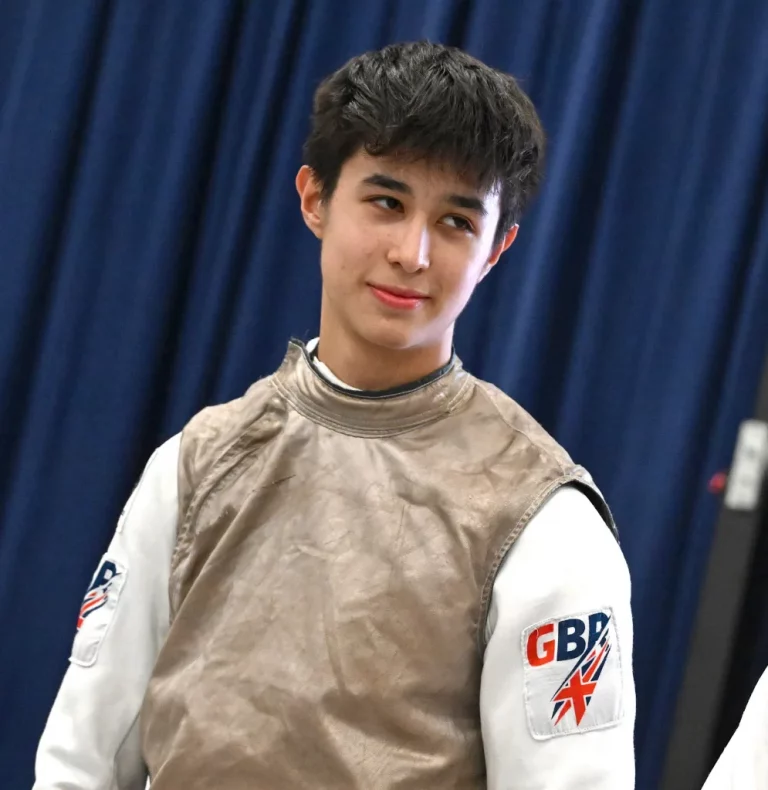
Step by step, British fencing is carving out a place among the world’s leading nations. At the 2026 European Cadet and Junior Championships, David Sosnov and Amelie Tsang embodied that surge in stature. One continental title, four further medals, and an all-British final in the men’s junior foil once again underlined the rapid rise of the sport across the United Kingdom.
Several of the fencers who shone in Tbilisi had already made their mark through precocious achievements and remarkably dense CVs at a young age.
David Sosnov, 18, arrived in 2026 as the reigning World Junior silver medallist and the world number one in his age group. Already capable of reaching quarter-finals on the senior circuit, he had established himself as the most advanced British foilist of his generation.
Amelie Tsang, World Cadet Champion in 2023, had previously etched her name into British fencing history by becoming one of the rare homegrown athletes to claim a global youth title. A European medallist in the lower age categories and already competitive against elite seniors, she has for several seasons represented the country’s most credible female foil prospect.
Around them, the depth continues to build. Jaimie Cook, senior national champion at just 18 and a European medallist at both cadet and junior level, has already tested himself at the Senior World Championships. Alec Brooke, World Junior silver medallist in épée, has demonstrated his ability to string together continental podiums. Cador Beautyman, firmly entrenched in the world top 10 at U20 level in épée, remains on a steep upward trajectory.
The foundations are clearly in place, and in Tbilisi two of the most eagerly anticipated names – Sosnov and Tsang – delivered once again on the big stage against the continent’s finest.
Tbilisi 2026 : European gold for Sosnov and five medals overall
David Sosnov’s coronation in the men’s junior foil was unquestionably the headline act of an otherwise hugely successful championship for the United Kingdom.
Dominant in the pools, he entered the direct elimination tableau with authority and swept aside his opponents in clinical fashion. The scorelines told their own story: 15–4 against Spain’s Uria Farres, 15–3 versus Ukraine’s Matiash, 15–9 against Hungary’s Grosz, and 15–5 over Germany’s Bergert. In the semi-finals, he faced Russia’s Dmitrii Chashchin and delivered another emphatic display, prevailing 15–4.
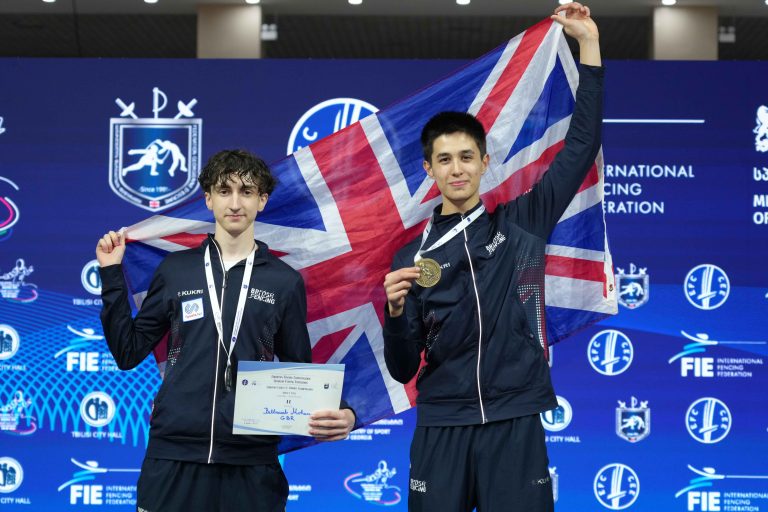
The final pitted him against compatriot Mohammed Belbouab in a historic all-British showdown. It proved to be Sosnov’s first genuinely tight contest of the day, eventually edging it 15–13 in a bout that showcased both nerve and tactical maturity.
Sosnov was crowned European junior champion. Belbouab claimed silver. Two Britons occupying the top two steps of the podium in a continental men’s foil championship – the image alone speaks volumes about the transformation of a nation that has not claimed Olympic fencing gold since 1964.
Belbouab’s run added further weight to the achievement. Seeded only 25th at the outset, he notably eliminated Russia’s Rostislav Khamdamov, the top seed in the draw. That detail matters, as this championship marked the return of Russian and Belarusian athletes to the international field. Russia, historically one of the great global powerhouses in fencing, rarely relinquishes medals lightly. Overcoming their representatives in full-strength draws only enhances the value of Britain’s haul.
The momentum did not stop with men’s foil. In the junior épée, Tristan Lumineau secured a bronze medal of his own. Unbeaten in the pools and ranked number one seed after the opening round, he lived up to his billing in the knockout stages with composed victories. A commanding 15–4 win over Azerbaijan’s Fatullayev in the quarter-finals guaranteed him a place on the podium. Though he was beaten 15–10 in the semi-finals by Israel’s Khaperskiy – the eventual champion – Lumineau’s bronze represents a significant continental medal for British épée and demonstrates that the nation’s progress is not confined to a single weapon.
The success extended into the team events. Sosnov and Belbouab, joined by David Kelly and Callum Penman, captured bronze in the men’s junior foil team competition. Controlled victories over Belarus and Slovakia set up a semi-final against France, which Britain narrowly lost. However, they regrouped superbly to defeat Hungary 45–43 in the bronze medal match. In the decisive final relay, Sosnov – as Britain’s leading foilist – assumed responsibility and closed out the contest, underlining his leadership credentials.
In the women’s field, Amelie Tsang also delivered. After a solid progression through the rounds, she reached the semi-finals of the junior foil. In the quarter-finals, she overcame Italy’s Jazmin Papp 15–8 to secure at least a medal. Her semi-final against Ludovica Franzoni was a gripping affair. Trailing for much of the bout, Tsang battled back to level at 14–14. The final touch proved decisive, and it was the Italian who prevailed, leaving Tsang understandably frustrated but adorned with bronze.
In total, the British Team departed Tbilisi with five medals: one gold, one silver and three bronzes. Three major individual podiums, a team medal, and a clear statement that men’s foil in particular has become a genuine area of strength.
Fencing offers substantial Olympic medal potential, with six individual and six team events on the programme. For a nation intent on maximising its podium prospects at Los Angeles 2028, the emergence of this generation provides tangible cause for optimism. The signs from Tbilisi suggest that British fencing is no longer merely developing – it is beginning to contend in earnest.