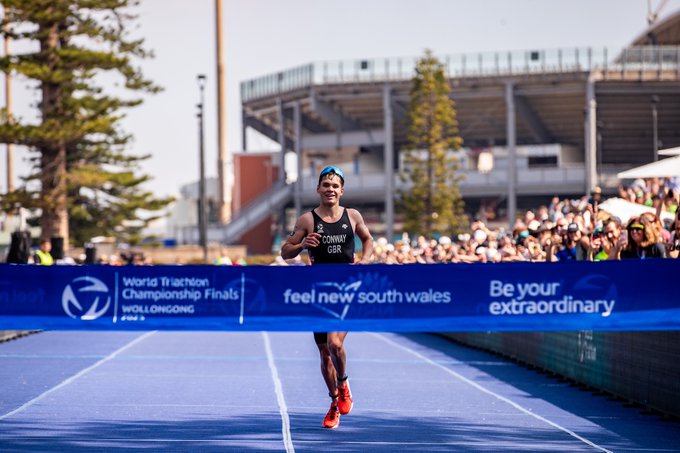
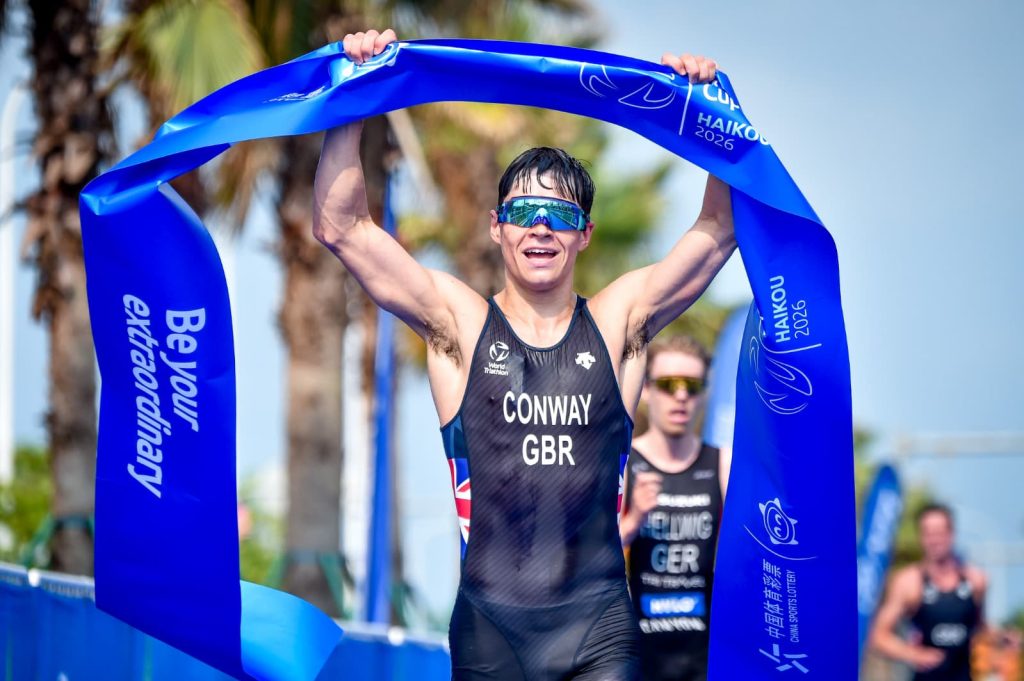
Oliver Conway wasted no time stamping his authority on the 2026 season. In Haikou, at the second stop of the World Triathlon Cup, the reigning 2025 U23 world champion delivered a statement victory, executing a perfectly controlled race from start to finish. Close behind, Hugo Milner surged to a well-earned podium, while the other British athletes finished 5th, 10th and 12th respectively — all underpinned by decisive run performances that have increasingly become the hallmark of British triathlon.
A fast, controlled race shaped by the British
This World Cup leg was contested over the sprint format (750m swim, 20km bike, 5km run), and from the outset, the swim began to shape the race dynamics. A lead group quickly emerged, with Michael Gar among the standout performers, exiting the water near the front and putting the British contingent in an ideal position heading into T1.
From there, the race quickly organised itself around a main peloton, though it did not remain intact for long. Driven by a fierce tempo, largely dictated by several international frontrunners, the field began to splinter. A breakaway group of around fifteen athletes gradually pulled clear, opening up a meaningful gap over the chasers, with strong British representation at the front.
Oliver Conway, already established as one of the most promising names on the circuit following his U23 world title, was highly active within this lead group. Alongside him were athletes such as Brandon Pye, a former middle-distance runner on the track, and Alex Robin, both contributing to what would become the decisive move of the race.
In contrast, Hugo Milner found himself slightly adrift heading into the second transition. Trailing by roughly thirty seconds after the bike leg, his podium hopes appeared to be slipping away at that stage, particularly given the calibre of athletes ahead of him.
The run: Britain’s decisive weapon
If modern triathlon is about balance across all three disciplines, the run remains the ultimate decider and in Haikou, that truth was once again underlined. It also highlighted a growing trend: British athletes are increasingly turning the final 5km into their strongest asset.
From the opening strides of the run, Michael Gar set an aggressive pace, attempting to stretch the lead group and force early gaps. However, the hierarchy soon began to shift. Gradually, Oliver Conway whose running pedigree stems from a strong background in cross-country and track moved smoothly to the front.
A product of Radley Athletics Club, Conway has developed within a system that blends triathlon with a strong athletics foundation. His experience in European cross-country competitions has given him the endurance and efficiency that now make a tangible difference at elite level.
As the race entered its final lap, Conway had worked his way back onto the leaders and began to bide his time. Then, in the closing stages, he delivered a decisive change of pace over the final few hundred metres. Germany’s Tim Hellwig attempted to respond — no stranger to success, the Olympic mixed relay champion from 2024 had already shown excellent early-season form with a runner-up finish in Lanzarote. Highly influential during the bike leg, where he played a key role in shaping the front group, Hellwig nevertheless had no answer to Conway’s finishing kick and had to settle for second place.
This ability to make the difference late on perfectly illustrates the evolution of modern triathlon. More than ever, races are won and lost on the run and in that department, the British are currently excelling.
Behind the battle for victory, Hugo Milner’s performance further reinforced that narrative. Producing the fastest run split of the day, he delivered a remarkable comeback to claim third place, despite not being in the lead group after the bike. It was a scenario reminiscent of his early days in the sport: already a World Cup winner in Miyazaki in 2023, Milner had made an immediate impact by consistently clocking the quickest run times.
Before turning to triathlon, Milner was among Britain’s leading cross-country runners, notably securing a national title in 2024. This British model is far from new — it follows a pathway established by leading figures such as Alex Yee and Beth Potter. Both transitioned from high-level athletics backgrounds, with Yee a national 10,000m champion and Potter a former Olympic track athlete.
In sprint-format racing, where time gaps remain minimal until the second transition, any weakness on the run is quickly exposed. Conversely, a strong athletics background has become almost essential for anyone aiming to succeed on the international stage.