The British women’s 4*400m relay may have left Gaborone without a medal, but certainly not without valuable lessons. From the heats alone, this squad reminded observers that it is one of the deepest in the world, delivering a genuine statement performance by blending experience with youth. As things stand, the women’s relay appears fully equipped to target gold at major championships, with a depth of talent never previously reached.
A statement in the heats and a wealth of options
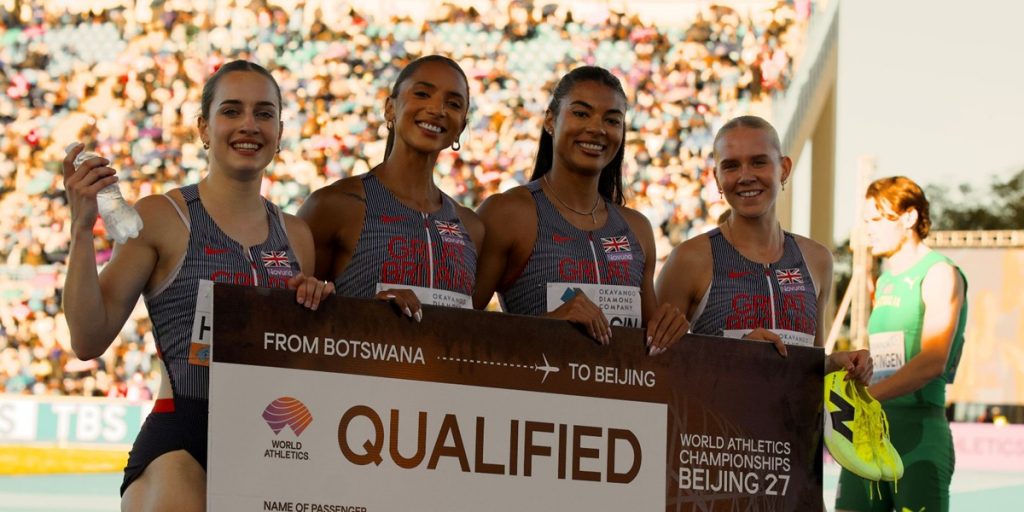
Some performances speak for themselves, and the one delivered in the heats in Gaborone falls firmly into that category. Clocking 3:21.28, the fastest time in the world at that point in the season, the quartet of Laviai Nielsen, Emily Newnham, Charlotte Henrich and Nicole Yeargin laid down a serious marker. All the more impressive given that the outdoor season had only just begun, and several key figures were still absent, most notably the British 400m record holder Amber Anning.
That time ranks as the fourth-fastest British performance in history. A clear indication of the current strength in depth, particularly when recalling that the national record (3:19.72) was set during the bronze medal performance at the Paris 2024 Olympic Games, courtesy of Victoria Ohuruogu, Laviai Nielsen, Nicole Yeargin and Amber Anning. On that occasion, the British quartet finished just a few hundredths behind the Netherlands (3:19.50), who themselves were beaten by the United States (3:15.27).
The final in Gaborone proved more frustrating. Finishing fourth in 3:22.77, the British team saw Norway produce a surprise national record of 3:20.96 to take victory ahead of Spain and Canada. A result below expectations, partly due to a reshuffled line-up, but one that should not overshadow the broader picture: the momentum remains clearly positive.
Charlotte Henrich, just 19 years old, delivered an outstanding flying leg of 49.40 seconds, one of the fastest splits in the final. It confirmed the emergence of a precocious talent, already crowned European U20 champion in 2025. Alongside her, Emily Newnham (21), primarily a 400m hurdles specialist, also impressed with a 49.09 split in the heats. Two young, versatile athletes already proving decisive.
It is also worth highlighting the contributions of the relay runners who consistently stepped up when required. On two occasions — in both the heats and the final, Yemi Mary John, the 2022 world U20 400m champion, managed to recover lost ground at the baton exchange, reeling in her rivals down the home straight. Meanwhile, Nicole Yeargin continues to establish herself as one of the key assets of British relay teams, having now been part of five of the seven fastest quartets in the country’s history.
Overall, the current depth is striking. Amber Anning, who has clocked an outstanding 49.29, remains the driving force of the squad. Laviai Nielsen (49.87), Yemi Mary John (50.50), Lina Nielsen (50.78), and now the younger generation of Newnham and Henrich — with Rebecca Grieve and Kara DaCosta, both developing within the NCAA system, potentially joining the mix by 2028 form a core capable of challenging for the gold medal.
And there is more, with a potential X-factor that could change everything: Keely Hodgkinson. The Olympic 800m champion has recently suggested she is open to competing in the 4x400m relay at future major championships. Not an unrealistic prospect, considering her remarkable 50.1 split at the World Indoor Championships : the fastest of the final, achieved less than an hour after winning the 800m title. Such an option could elevate the British 4x400m relay into a genuine gold medal contender, especially alongside athletes such as Amber Anning, Yemi Mary John, Emily Newnham or one of the Nielsen sisters.
In a similar vein, Dina Asher-Smith has also been seen in experimental relay line-ups, underlining the versatility within the squad and the ever-expanding talent pool. At present, there are at least seven athletes capable of running sub-50 splits in relay conditions, with several others operating at a comparable level.
Ultimately, what emerges from these World Relays is clear: with a high-performing young generation, an established elite, and multiple tactical options, all the conditions appear to be in place for British success, and potentially gold in the years to come.