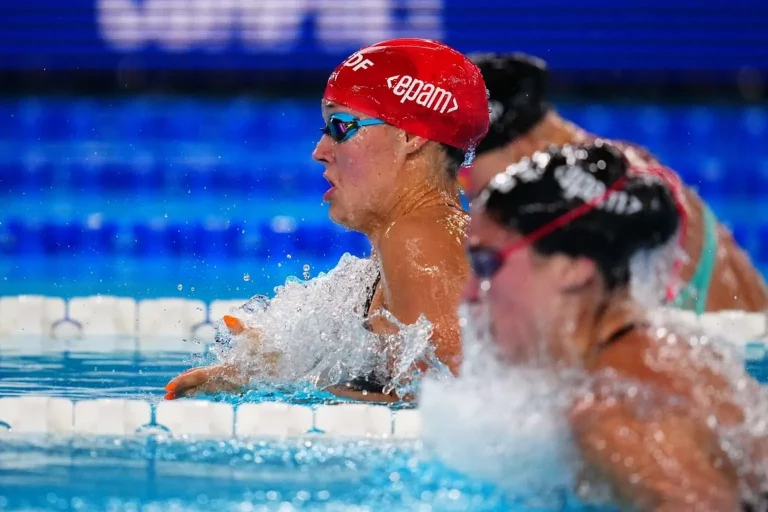
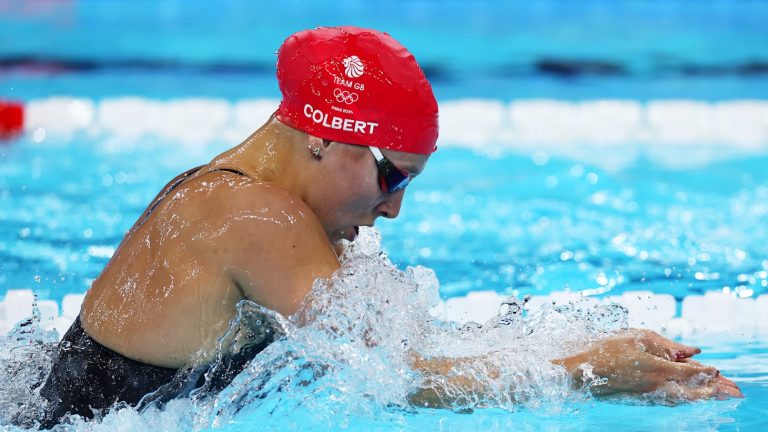
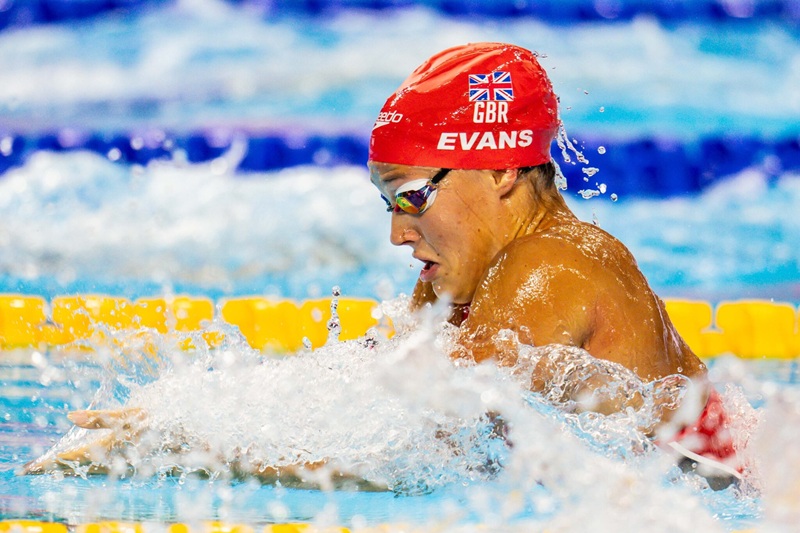
Freya Colbert and Angharad Evans delivered standout performances on the third evening of the British Swimming Championships. At the London Aquatics Centre, the former lowered her own national record in the 200m freestyle, while the latter became the first British swimmer in history to break the 2:20 barrier in the 200m breaststroke.
World-class performances from Colbert and Evans
Freya Colbert struck first in the 200m freestyle, clocking 1:54.34 to improve the British record she had set herself in Edinburgh (1:54.98) by 0.64 seconds. It marks a clear progression within a broader trend: in less than a year, the Loughborough swimmer has taken 1.42 seconds off her time, having swum 1:55.76 at these same championships last year.
After a controlled morning swim of 1:58.76 (58.17/1:00.59), which only placed her third in the heats, she shifted gears completely in the final. She increased the pace from the outset, turning at 100 metres in 55.79 — more than two seconds faster than in the morning — with splits of 27.30 and 28.49. It was her third 50 metres that proved decisive: 29.09, compared to 29.47 in her previous record. At that point, she was already 0.59 seconds ahead of her former mark. She closed in 29.46 to stop the clock at 1:54.34.
Colbert’s splits and progression in detail :
27.30 / 28.49 / 29.09 / 29.46 (1:54.34) compared to
27.47 / 28.63 / 29.47 / 29.41 (1:54.98) in Edinburgh
This performance immediately places her among the global elite: third-fastest time in the world this season, behind 1:53.52 from Australia’s Mollie O’Callaghan and 1:53.80 from Canadian star Summer McIntosh. Crucially, she is also the fastest European by more than 2.5 seconds. She now ranks as the tenth-fastest woman in history over the distance and the sixth-fastest European of all time.
In concrete terms, her 1:54.34 would have secured silver at the most recent World Championships, underlining the true level of this swim.
Just minutes earlier, Angharad Evans had already set the tone with a historic race in the 200m breaststroke. She claimed victory in 2:19.70, taking 1.19 seconds off the British record of 2:20.89, previously held since 2021 by Molly Renshaw.
Her race execution was outstanding, built on a very fast opening 50 in 31.97 : the only swimmer under 32 seconds, followed by three well-balanced splits of 35.26, 35.92 and 36.55. Only the final 50 was slightly slower, matching the level of her previous best:
31.97 / 35.26 / 35.92 / 36.55 (2:19.70) compared to
32.34 / 35.71 / 36.38 / 36.56 (former record)
She too moves firmly into the world elite. Evans becomes the ninth-fastest performer in history and only the eleventh swimmer ever to go under 2:20. She also sets the fastest time in the world this season, ahead of the 2:20.86 posted by reigning world champion Kate Douglass.
Perhaps most significantly, she lowers her previous personal best (2:21.86) by more than two seconds, highlighting a clear step up in performance. She will now head into the 2026 European Championships in Paris as the leading contenders in the event.
The rest of the evening’s results
In the 100m freestyle, Matt Richards retained his national title in 47.53 after a well-controlled race. Trailing at the turn, he produced a strong final 50 metres to pull clear of Jacob Mills (48.09, born in 2007) and Jacob Whittle (48.52).
In backstroke, Oliver Morgan confirmed his status by winning the 100m in 52.41, close to his top level, while Lauren Cox secured her second title of the championships in the 50m backstroke (27.39), following her victory in the 100m. Distance events also featured, with Reece Grady taking the 1500m freestyle in 15:14.76.
Finally, the women’s 200m freestyle highlighted the depth of British swimming. Behind Colbert, Freya Anderson (1:57.00), Leah Schlosshan (1:57.49) and the young Theodora Taylor (1:58.31, born in 2009 and setting an age-group record) combined to form a highly competitive relay quartet. Their combined time of 7:47.14 is well inside the European qualifying standard of 7:54.25, putting them in a strong position to challenge for top honours this summer, where their main rivals are expected to come from Hungary.