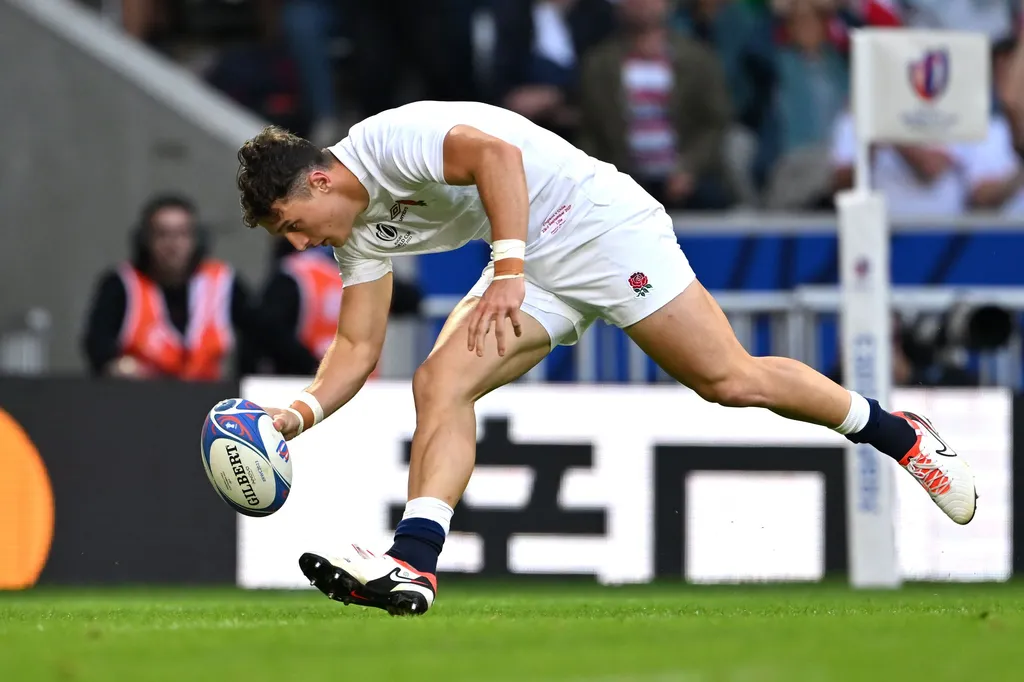
Just days before the start of the 6 Nations Championship, Steve Borthwick moved early by naming his England side to face Wales at Twickenham. It is a reshaped and ambitious England team, but one defined above all by a bold decision: Henry Arundell will start on the left wing. At just 23 years of age, the former London Irish prodigy earns his first England start since the 2023 Rugby World Cup, marking a significant moment in both his career and England’s evolving backline.
A bold selection to launch the Championship
England head into their opening Six Nations fixture with a line-up that raises eyebrows, starting with a decision heavy in symbolism: Maro Itoje begins the match on the bench. It is the first time in many years that the England lock, a cornerstone of the national side, has not been named in the starting XV. While the call is partly explained by human considerations — Itoje recently lost his mother and missed the start of England’s training camp — it also reflects Steve Borthwick’s desire to manage his leaders differently and build a squad capable of sustaining intensity across the full 80 minutes.
That approach is particularly relevant in this edition of the Six Nations, which will be played over six weeks rather than the traditional seven, placing greater physical and mental demands on squads. Rotation, squad depth and impact from the bench are therefore central to Borthwick’s thinking.
Nowhere is that clearer than on the replacements’ bench, which is once again stacked with power and experience. Six forwards are named among the substitutes, several of them proven performers at the highest level. Five of those players were part of the British & Irish Lions tour last winter, underlining England’s intention to dominate the physical battle late in games. Tom Curry, Luke Cowan-Dickie, Henry Pollock and Itoje himself form a “bomb squad” capable of shifting the momentum after the hour mark — a tactic Borthwick has increasingly relied upon in recent Tests.
Behind the scrum, the England head coach has also made structural decisions that hint at a broader tactical vision. Tommy Freeman’s move into the centres, wearing the No.13 jersey alongside his Northampton team-mate Fraser Dingwall at inside centre, is one of the defining features of this selection. Long deployed on the wing, Freeman continues his transition towards a more central role, where his power, pace and line-breaking ability can be used in a different way.
The Freeman–Dingwall partnership is not an experiment. The duo have already been paired twice at international level: first against Australia during the Autumn Nations Series, and again against Wales in last year’s Six Nations. Their existing understanding, built at club level with Northampton Saints, offers England rare continuity in midfield.
That shift, however, has had a direct consequence: it opens up a place on the wing. An opportunity seized by Henry Arundell, who became eligible for England selection again last summer following his return from France. His move to Racing 92 had temporarily ruled him out of international contention due to the RFU’s policy on overseas-based players. Now back on English soil with Bath, Arundell sees his England career reignited at precisely the moment the national side are seeking more pace and unpredictability out wide.
Arundell’s inclusion is far from a gamble plucked out of thin air, but it remains a strong statement given the winding path his career has taken over the past two seasons. His spell in France encapsulates the “Arundell paradox” perfectly. On the one hand, he produced moments of breathtaking brilliance — most notably a hat-trick on his first Top 14 start. On the other, he endured long spells where his influence faded, a frustrating pattern for a player blessed with such explosive athletic gifts.
Statistically, his time at Racing 92 was respectable: 14 tries in 26 Top 14 appearances. Yet numbers only tell part of the story. In a league where consistency, defensive reliability and off-the-ball work are non-negotiable, Arundell never fully convinced over the long term. Still developing defensively, occasionally exposed under the high ball or within structured kicking games, he often looked like a player still learning how to fit into a highly organised collective — very different from the environment he had known at London Irish.
His return to England, and specifically his move to Bath, appears to have marked a turning point. Back in familiar surroundings, Arundell has found greater consistency. His off-the-ball work has improved, his defensive contribution has grown and his finishing remains as lethal as ever. This season, he has already scored nine tries in all competitions, but more importantly, he has become a more constant presence in matches, even when opportunities are limited.
At just 23, Arundell remains both a project and a proven talent. His explosive arrival on the international scene — highlighted by a sensational solo try against Australia at the age of 19, followed by five tries against Chile at the 2023 World Cup — may have created expectations that were almost impossible to meet. His French detour slowed that momentum, but it also forced him to mature, adapt and refine the less glamorous aspects of his game.
From a purely tactical perspective, his selection offers England something different to Tommy Freeman. Where Freeman brings versatility, physical robustness and game intelligence, Arundell provides raw pace, electric footwork and the ability to turn half-chances into decisive moments. He is the kind of winger who keeps defences on edge, reluctant to over-commit for fear of being exposed.
The key, however, will be getting him the ball. As Sir Clive Woodward recently pointed out, Arundell has too often been a peripheral figure in Test rugby, starved of opportunities. His selection will only make sense if England’s game plan is designed to involve him — using Dingwall’s direct running, Freeman’s ability to hit gaps and George Ford’s kicking game to engineer one-on-one situations on the left flank.
While Arundell may initially benefit from Tom Roebuck’s injury to secure this start, a standout performance on Saturday could significantly alter the pecking order. One thing is certain : this is a golden opportunity for Henry Arundell to remind everyone why he was once considered one of the most exciting young talents in English rugby, and to stake a lasting claim in Steve Borthwick’s England setup.