After more than a decade of sporting and financial turmoil, Newcastle — now rebranded as Newcastle Red Bulls may finally be starting to see light at the end of the tunnel as the club enters a new era. Taken over in the summer of 2025 by Austrian energy drink giant Red Bull, the club has changed its name, its scale… and above all, its ambitions. Backed by unprecedented resources, the Kingston Park outfit have embarked on a wide-ranging overhaul of their playing squad. Bottom of the Premiership this season, can Newcastle realistically hope for a swift revival? Between targeted recruitment, a medium-term vision and a gradual return to the European stage, the club are attempting to rebuild step by step.
A once-proud institution in decline
For a long time, Newcastle embodied a certain idea of English rugby : a popular club, deeply rooted in its community, capable of producing exceptional talent while occasionally competing with the established powers. The Premiership title won in 1998, inspired by a 19-year-old Jonny Wilkinson, remains to this day the defining memory of a bygone era. Since then, the club from Tyne and Wear have slipped steadily, and seemingly inexorably towards the depths of the Premiership.
Recent seasons have been particularly unforgiving. Finishing bottom of the table three times in the last four campaigns, Newcastle have become perennial survivors, more concerned with firefighting than with building a coherent long-term project. The current 2025–26 season perfectly illustrates this structural malaise: after ten rounds, just one win, a porous defence that has conceded 439 points, and a worrying points differential that highlights the growing gap between Newcastle and the rest of the elite.
This decline is not purely sporting. It is also symptomatic of an English rugby landscape weakened by financial instability, where historically less wealthy clubs have paid the heaviest price. Geographically isolated, Newcastle have long functioned as a feeder club… for others. Too often, their brightest prospects have been forced to head south in search of silverware and exposure at leading clubs : as illustrated most recently by Ben Redshaw’s departure.
The Red Bull turning point and large-scale recruitment
The Red Bull takeover, officially completed in the summer of 2025, represents a clean break from this cycle of resignation. Beyond the name change, the transition from Newcastle Falcons to Newcastle Red Bulls symbolises a deep transformation of the club’s identity and ambitions. By absorbing significant debt, stabilising infrastructure and reshaping the sporting governance, the Austrian group has given Newcastle what they have lacked for years: vision and financial muscle.
Rather than pursuing a flashy revolution built on headline-grabbing signings and risky gambles, Newcastle have adopted a more nuanced approach. The aim is not to turn everything upside down in a single season, but to restore credibility both on and off the pitch. That has meant recruiting heavily, yes — but above all intelligently, focusing on players in their prime who are already accustomed to the demands of top-level rugby, rather than big names offering more marketing value than sporting substance.
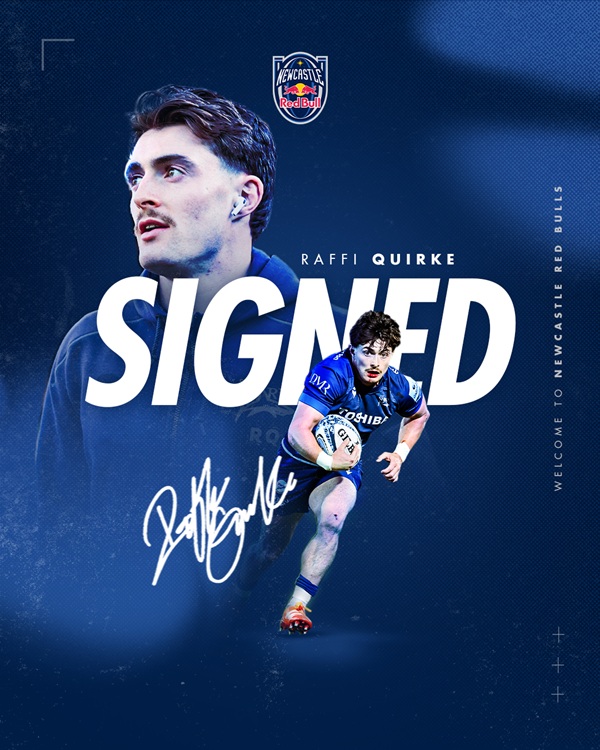
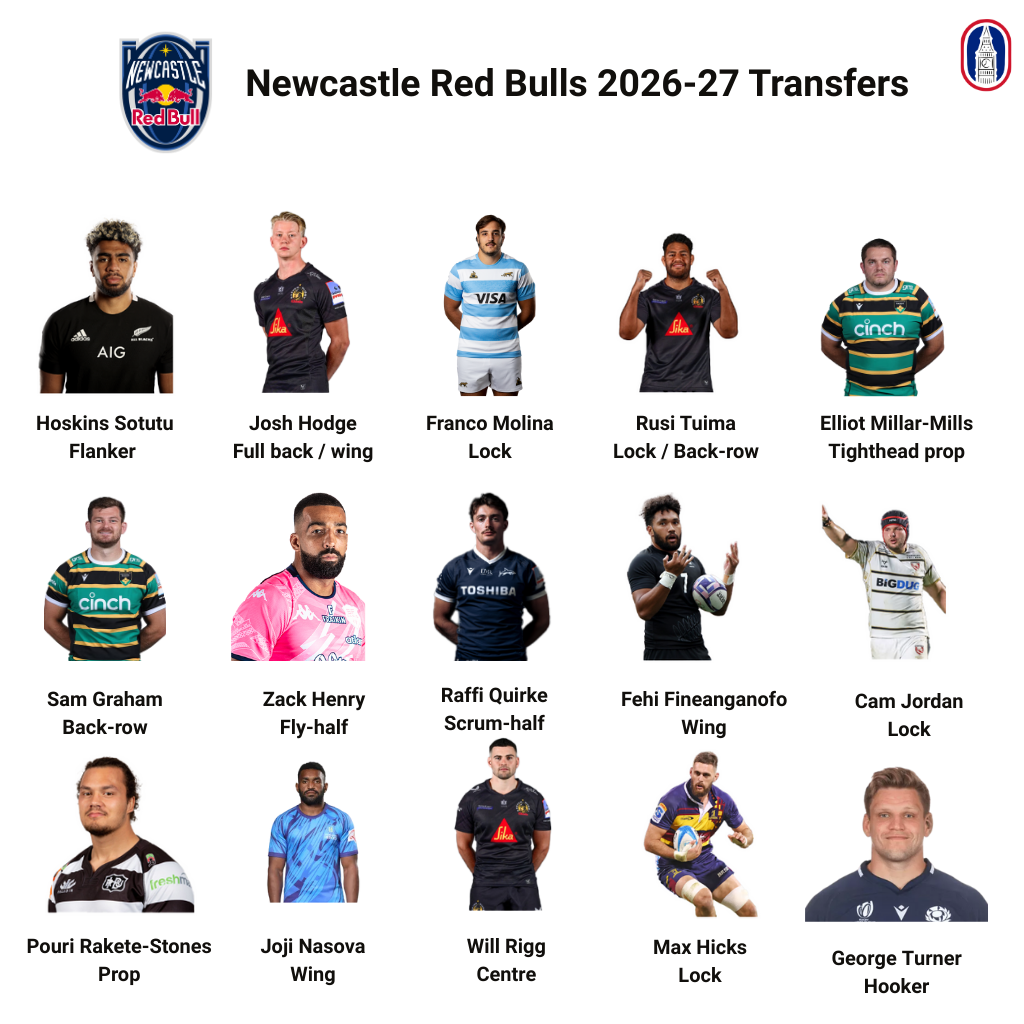
Quietly, Newcastle have begun to attract profiles capable of reshaping the team’s identity. Few signings symbolise this renewed appeal better than the arrival of Raffi Quirke. Just 24 years old, the Sale Sharks scrum-half represents a statement of intent. Capped twice by England and regularly involved in Steve Borthwick’s wider training squads, Quirke is not a long-term punt but an immediately competitive player. Quick off the base, explosive around the ruck and capable of breaking defensive lines with his initiative, he brings exactly what Newcastle have lacked in recent years: tempo, personality and a constant threat close to the try line. His signing makes him the first player closely linked to the England setup to fully commit to the Red Bull era : a powerful symbol for the club.
Alongside him, Newcastle have strengthened their foundations with reliable, hybrid forwards. Rusi Tuima, recruited from Exeter, is a prime example. Developed at the highest level and capped across England age-grade sides up to England A, the 25-year-old lock/back-row has forged a solid reputation in the Premiership. Standing at 1.95m and weighing 128kg, Tuima offers obvious physical presence, thrives in contact and excels in the unseen work. His arrival provides much-needed ballast to a pack that has too often been overpowered, reinforcing the basics without which sustained success is impossible.
In the backs, Newcastle have resisted the temptation to simply stockpile pace on the wings. The signing of Will Rigg, a centre also arriving from Exeter, reflects a more collective logic. At 25, Rigg is no superstar, but he is dependable: strong defensively, effective at punching holes, and capable of creating space for those around him. Yet the most symbolic signing from Exeter remains Josh Hodge. A Newcastle academy product who left to further his development at the Chiefs, the England A international returns home with a different status. More mature, more complete, and with nearly 90 Premiership appearances to his name, Hodge embodies a clear message: Newcastle can once again be a club players return to in order to win, not merely a stepping stone. His homecoming is as cultural as it is sporting.
Constant squad turnover and an unstable sporting project
Beyond the headline names, the scale of Newcastle’s transformation is best measured numerically. For the upcoming season alone, the club have already brought in 14 new players, on top of nearly 20 arrivals the previous year. Rarely has a Premiership side undergone such radical squad turnover across two consecutive campaigns. At the same time, departures have been numerous : some enforced, others strategic, underlining a clear desire to sever ties with a failing cycle. This instability inevitably raises a key question: how do you quickly build cohesion, identity and leadership within such a heavily reshaped group ?
Rather than projecting a fixed first-choice XV, it makes more sense to examine the internal dynamics likely to shape the side. Certain players appear destined to become automatic starters. Quirke, for instance, arrives with a status that immediately places him at the heart of the project, frequently competing with Jack van Poortvliet as England’s third-choice scrum-half. His modern skill set makes him a natural focal point for Newcastle’s attacking structure.
In the pack, Tuima looks equally set for a long-term role. His versatility, work rate and reliability in the tight exchanges address longstanding deficiencies. Around him, less heralded players including several already at the club, could also benefit from a more stable environment and improved support structures.
Further out, Hodge’s return opens multiple options. Comfortable at full-back or on the wing, with a reliable boot and strong counter-attacking ability, he could quickly become a leader in the back three. Rigg, meanwhile, may profit from existing chemistry with former Exeter teammates, offering immediate continuity in a team still finding its feet. Competition remains fierce and deliberately so, as the coaching staff seek to create internal pressure where depth has long been lacking.
This accelerated rebuild inevitably places the coaching staff under scrutiny, starting with the head coach. Appointed only recently, he too is working with a constantly evolving squad shaped by decisions that sometimes extend beyond pure sporting considerations. In a club now run by a multinational organisation with high expectations, patience is far from guaranteed. Will he be the man to provide long-term stability, or merely a transitional figure in a project still taking shape?
On the pitch, Newcastle will need to proceed carefully. While momentum appears to be improving, ambitions must remain measured in the short term. Even if European qualification is secured, it would be unrealistic to target more than a quarter-final run. The reasons are clear: the level of opposition is formidable. Between clubs with deep European pedigree and teams dropping down from the Champions Cup, collective experience will count for a great deal. Newcastle, still in a learning phase, may quickly encounter the limits of a young project.
In the medium term, however, the narrative shifts. Red Bull have been transparent: the true impact of the project is expected within three to five years. Academy development, retention of local talent and renewed attractiveness in a region historically overlooked by the Premiership form the backbone of this strategy — and geography could prove decisive.
Isolated at the top level, Newcastle sit within an almost untapped catchment area. Sale Sharks are the nearest Premiership neighbours; beyond that, Leicester lie a considerable distance away. The North East, Cumbria, and even areas such as York, Leeds and their surrounding suburbs represent a vast, underexploited talent pool. In this context, Newcastle could naturally become the destination of choice for northern prospects long forced to migrate south or into the Midlands to reach the elite.
The example of Sedbergh School in Cumbria illustrates this potential perfectly. The prestigious private school has produced numerous professional players. The recent case of Ben Redshaw, a former pupil who left for Gloucester at just 21 — is a stark reminder of what Newcastle have too often lost. With modernised facilities, increased visibility and a coherent pathway, the club could finally reverse this trend and reclaim its role as the beating heart of northern English rugby.