Tito Odunaike, Moyo Stumpenhusen, Emilia Adese or Harley Henry are all among those who have marked a clear turning point for British youth athletics. Over the space of just two days, athletes from across the United Kingdom delivered a remarkable haul of qualifying standards for the European Under-18 Championships and the World Under-20 Championships, while also setting multiple national age-group records. Most strikingly, these breakthrough performances came not on the track, but in the field events – jumps and throws – disciplines in which Britain has traditionally struggled to assert itself at the highest international level.

The first major wave of standout results came in Växjö, Sweden, where it proved to be a hugely productive day for British throwers. In the men’s U18 discus, Moyo Stumpenhusen, who has emerged rapidly over the past year, claimed second place with a throw of 57.47m. That mark comfortably secured the European U18 qualifying standard for Rieti and also established a new British U18 record. It underlined the swift rise of an athlete now capable of competing with the very best European specialists in his age group, even if victory on the day went to Sweden’s George Cederqvist, who stunned the field with a massive personal best of 58.33m, an improvement of more than seven metres.
In the women’s U18 shot put, British athletes were firmly in control. Emilia Adese took victory with a throw of 16.87m, a significant personal best and well beyond the European qualifying standard of 15.60m. Jasmine Nkoso, better known as a multi-eventer, also surpassed the mark with 16.09m, highlighting her versatility and raw power. The two Britons now sit among the very best in the world for 2026, with Adese ranked world number two U18 and Nkoso world number five. Meanwhile, Lucy Bull added to the remarkable day by throwing 49.84m in the javelin, setting another British U18 record. Three national U18 records in the throwing events on a single day is an exceptionally rare occurrence for the United Kingdom.
Attention then shifted to the jumps, where performances reached an equally impressive level. The standout name was undoubtedly Tito Odunaike. Born in 2009, the British triple jumper made an immediate impact with an opening leap of 15.18m, securing the European U18 qualifying standard and moving to the top of the world U18 rankings. What followed was even more eye-catching. Odunaike improved to 15.91m, before producing a sensational 16.01m in Sheffield. That mark represents the best British U18 triple jump of all time, and the longest indoor jump achieved globally in the age group for over a decade.
In the same competition, Harley Henry, still only 17, confirmed his reputation as one of Britain’s most precocious talents. Already the youngest male athlete ever to represent the UK at the European U20 Championships last season, Henry extended his personal best to 15.75m. The jump earned him the World U20 qualifying standard for Eugene and lifted him to third in the U20 world rankings for 2026. Britain now finds itself with two teenage triple jumpers operating at genuine international level, something previously unseen in this event.
The high jump also delivered a major success through Regan Corrin. Clearing 2.15m to win the men’s U20 competition, Corrin set a personal best and secured the World U20 qualifying standard. The performance places him firmly in contention for future international selection, with a potential pathway towards representing the Isle of Man at the 2026 Commonwealth Games, following in the footsteps of athletes such as Otis Poole.
In the long jump, Daniel Emegbor once again demonstrated why he is regarded as one of the world’s leading young talents. With his very first attempt, he soared out to 7.73m, a jump that both met the World U20 qualifying standard and stands as the world-leading U20 performance of the season. Emegbor’s credentials are already well established: at just 16 years old, he finished fifth at the European U20 Championships, underlining his exceptional level of development.
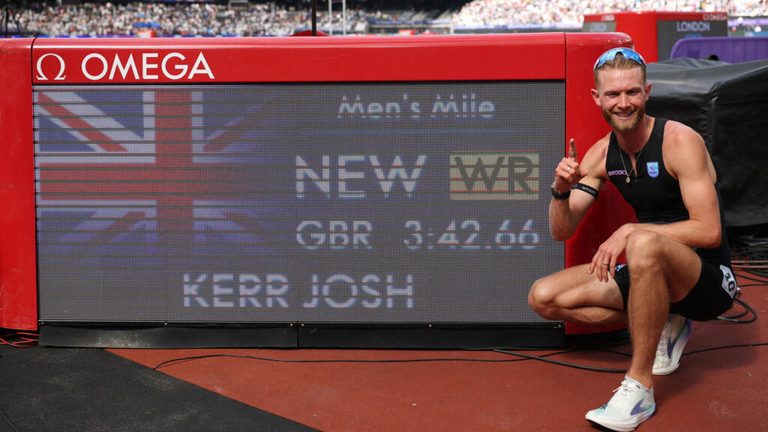
Taken together, these results highlight a significant shift in British youth athletics. In recent years, international qualifying standards and headline performances have more commonly emerged from sprinting and middle-distance running. Britain has built a formidable legacy in events such as the 800m and 1500m, with historic figures including Sebastian Coe, Steve Cram and Kelly Holmes, followed more recently by Laura Muir, Josh Kerr and Keely Hodgkinson. That sustained success on the track has often masked a comparative lack of depth in the field events.
To now see such a concentration of qualifying standards and elite-level performances in the throws, triple jump, long jump and high jump sends a powerful signal for the future. It suggests a broader, more balanced talent base and an improved capacity to develop world-class athletes across the full spectrum of athletics disciplines. At present, pole vault remains the notable exception at youth level – an event in which Britain has historically struggled – despite the recent senior breakthrough of Molly Caudery on the international stage.
With the European U18 Championships in Rieti and the World U20 Championships in Eugene fast approaching, the United Kingdom heads into the summer with a level of depth in the field events rarely seen before, while still retaining its traditional strength in sprinting and middle-distance running.
Find here the other qualifying qualifying standards achieved over the weekend, mainly in the sprint and middle‑distance events.