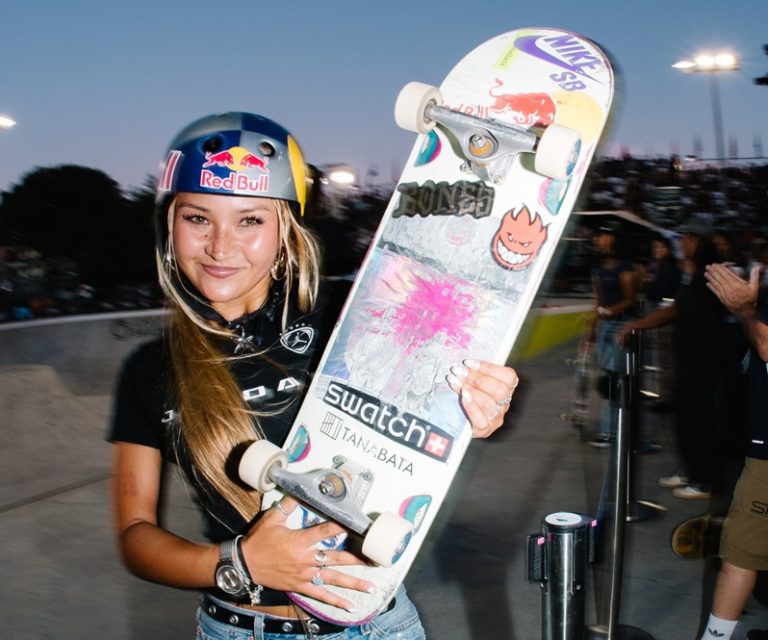
At just 17 years old, Sky Brown continues to carve out a remarkable place in British sporting history. Already a two-time Olympic medallist, the skateboarding prodigy claimed her second world title at the World Skateboarding Championships held in São Paulo. In a final disrupted by heavy rain, the British star once again showcased her immense talent to come out on top against an exceptionally strong field, reclaiming the crown she had first captured in 2023.
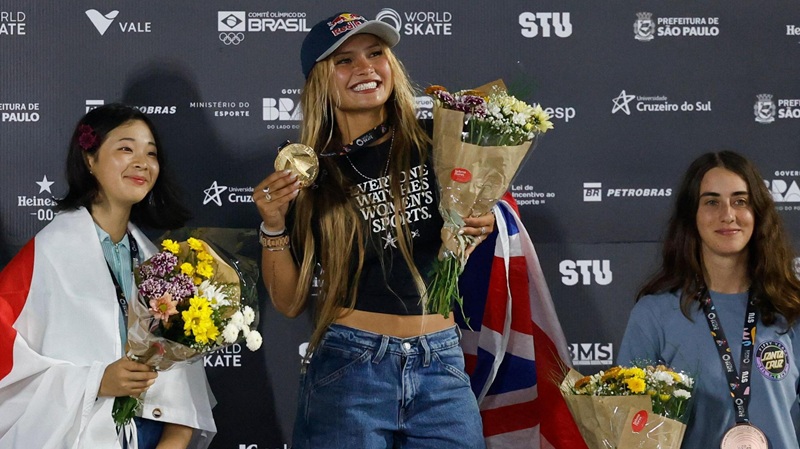
An intense final in São Paulo brought to an early halt by the rain
The scene was set in São Paulo for one of the most eagerly anticipated finals of the championships. In the women’s park event, eight of the best riders on the planet lined up with the aim of securing the world title. Among them, Sky Brown naturally stood out as one of the favourites, drawing on experience well beyond her years and a résumé that is already impressive despite her young age.
From the very start of the final, Brown made her intentions clear. In her opening run, she posted a solid score of 83.90, immediately placing herself among the contenders for the top spot, although it seemed unlikely at that stage to be enough to secure the gold medal. Determined to raise the bar, the British teenager delivered when it mattered most.
On her second run, Brown elevated her performance to another level, improving her score to an impressive 88.16. The run was a perfect reflection of her trademark style : smooth and flowing lines through the bowl, powerful airs and a level of composure that continues to set her apart. It was a performance that combined technical quality with creativity, leaving a strong impression on the judges and ultimately proving decisive.
Just as the riders were preparing for the third and final run of the contest, however, the weather dramatically changed the course of the competition. Heavy rain began to fall over the Brazilian skatepark, making the surface increasingly slippery and dangerous for the athletes. What had been a thrilling final suddenly turned into a long wait as organisers monitored the conditions.
After several minutes of uncertainty and discussions among officials, the decision was eventually made to bring the competition to an early conclusion. With the rain showing no signs of easing and safety becoming the priority, organisers confirmed that the final standings would be based on the results after the first two runs.
That meant Sky Brown, with her score of 88.16, remained at the top of the leaderboard and was officially crowned world champion for the second time in her career. Japan’s Mizuho Hasegawa secured the silver medal with a score of 84.36, while American rider Minna Stess completed the podium in third place with 83.90. Reigning Olympic champion Arisa Trew of Australia finished just outside the medals in fourth position.
Although the final could not unfold exactly as planned, Brown’s victory was widely viewed as fully deserved. Her two runs had already demonstrated a clear level of control and technical quality that placed her ahead of the rest of the field.
Still, the British skateboarder admitted afterwards that she would have preferred the chance to see the battle through to its conclusion.
“The level is crazy. I wish we could have really battled it out until the end,” Brown said after the final. “Girls like Arisa and Mizuho are incredible, and I know the final could have been even more intense.”
Since bursting onto the international scene, Brown has consistently pushed the boundaries of what is possible for such a young athlete. She first made global headlines at the Tokyo Olympic Games in 2021, where she claimed bronze in the women’s park event at the age of just 13, becoming the youngest Olympic medallist in British history.
Three years later, she proved that performance was no one-off. At the Paris 2024 Olympic Games, Brown once again secured a bronze medal in the same discipline. The achievement was made even more remarkable by the circumstances: she competed despite having recently dislocated her shoulder, meaning she was unable to perform at her absolute peak, which may have costed her the gold medal.