The Milan–Cortina Winter Paralympic Games have only just begun, but after a few disappointing early results the British delegation already has a major highlight to celebrate. Visually impaired alpine skier Neil Simpson, guided by Rob Poth, claimed the silver medal in the alpine combined event. The performance allows the United Kingdom to open its medal tally at these Games and further confirms Simpson’s place among the leading figures in world Para alpine skiing. At just 23 years of age, the British athlete continues an impressive trajectory, four years after his historic achievements in Beijing.
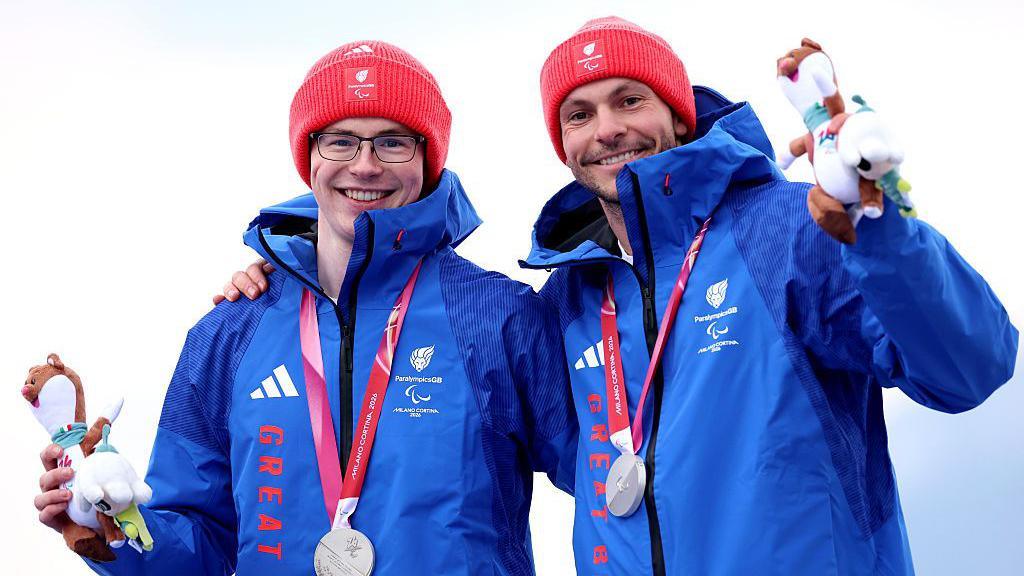
Neil Simpson launches Britain’s campaign with a silver medal
At major sporting events, the first medal always carries special significance. It sets the tone, relieves pressure and injects momentum into the rest of the team. In Milan–Cortina, that honour belongs to Neil Simpson and his guide Rob Poth, who finished second in the alpine combined in the visually impaired category.
The morning had begun cautiously for the British pair. Racing on the Tofane slope, Simpson and Poth clocked the fourth-fastest time in the Super-G, finishing just 0.57 seconds outside the provisional podium places. It was a solid position, but one that also carried the risk of further frustration after two fourth-place finishes already recorded earlier in the Games.
However, the British duo delivered when it mattered most in the second leg of the competition. In the slalom run, Simpson produced a superb performance, expertly guided by Rob Poth down the technical course. Their time of 42.52 seconds proved to be the fastest of the entire slalom leg, allowing them to climb two places in the overall standings and secure the silver medal.
Only the Italian pairing of Giacomo Bertagnolli and his guide Andrea Ravelli managed to finish ahead. The reigning Paralympic champions delivered another outstanding performance to claim gold, finishing 0.65 seconds ahead of the British duo. Austria’s Johannes Aigner, skiing with guide Nico Haberl, completed the podium in third place.
For Simpson, this silver medal marks the third Paralympic medal of his career. At the Beijing Winter Paralympics in 2022, he had already claimed gold in the Super-G and bronze in the combined event. On that occasion, he was guided by his brother Andrew Simpson, and together they made history by becoming the first British male athlete to win a Paralympic gold medal in alpine skiing.
Born with nystagmus, a condition that causes involuntary eye movements and significantly impairs vision, Simpson competes in the B3 classification for visually impaired athletes. In Para alpine skiing, the partnership between athlete and guide is absolutely crucial. The guide skis ahead of the athlete, communicating constantly through radio headsets to provide instructions about the racing line, speed and obstacles on the course.
That relationship of trust is essential when racing at speeds that can exceed 100 kilometres per hour on demanding mountain slopes. In Milan–Cortina, Rob Poth – competing in his first Paralympic Games – fulfilled that role superbly. His guidance allowed Simpson to attack the course with confidence, particularly during the decisive slalom run that ultimately secured the podium finish.
As a result, the silver medal belongs just as much to Poth as it does to Simpson, underlining the unique nature of visually impaired alpine skiing where success is always shared between athlete and guide.
For the British delegation, the result provides a welcome boost early in the Games. Opening the medal tally often helps settle nerves within a team and can inspire other athletes still to compete. UK Sport had set expectations ahead of the Games of between two and five medals for Great Britain, following the six medals won at the Beijing Paralympics four years ago.
Simpson’s podium finish therefore represents a strong start towards that target.
Yet the British skier’s campaign in Milan–Cortina is far from over. Simpson and Poth are still set to compete in both the giant slalom and the slalom events later in the programme. In both disciplines they possess strong credentials and considerable experience at the highest level of Para alpine competition.
Their impressive performance in the slalom leg of the combined event may even suggest that the duo could challenge for an even higher position on the podium in the coming races.