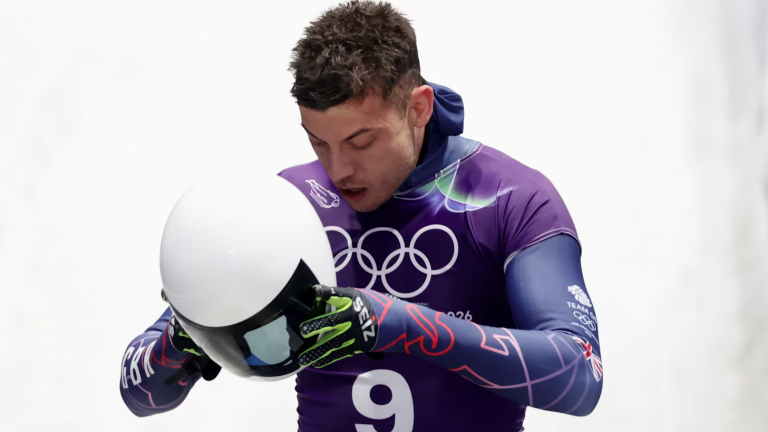
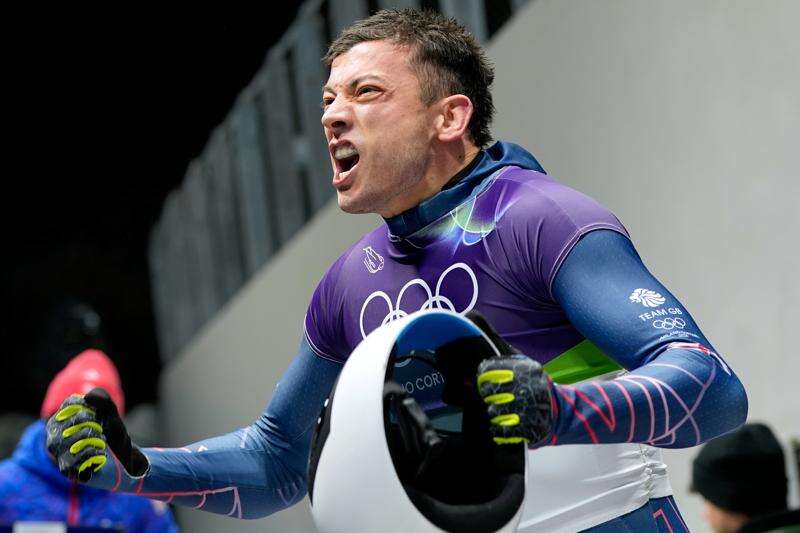
History has been made. In Cortina d’Ampezzo, Matt Weston on Friday became the first British man ever to be crowned Olympic champion in skeleton. Dominant from start to finish, leading after every heat, the reigning world champion turned his status as favourite into the ultimate prize. The gold medal is the United Kingdom’s first of the Milan-Cortina 2026 Winter Games.
Four runs, four records: a flawless display
The Olympic skeleton format leaves nowhere to hide: four runs across two days, the standings decided on aggregate time, with consistency the only currency that counts. Weston understood that better than anyone.
He laid down a marker immediately with a 56.21 in the opening run — a new track record. He followed it with 55.88 in the second, then 55.63 in the third. Each time down the ice, a fresh record. Each time, he edged further clear, moving ever closer to the ultimate coronation.
In the final run, when he could have played it safe under pressure, he did the opposite. 55.61 seconds. Even quicker. Another track record. Four runs, four fastest times — a perfect Olympic competition.
His combined time of 3:43.33 secured gold by 0.88 seconds from Germany’s Axel Jungk (3:44.21), with defending Olympic champion Christopher Grotheer taking bronze in 3:44.40. Weston was never truly under threat. He had built a 0.30-second advantage after the first two runs and never allowed it to slip. If anything, he tightened his grip.
This triumph goes beyond individual achievement. It marks a significant chapter in the history of British winter sport. Weston becomes the first British man to win Olympic skeleton gold, joining Amy Williams (2010) and Lizzy Yarnold (2014, 2018) among the discipline’s Olympic greats.
For the British delegation, it is a first medal of these Games after several agonising near-misses. It lifts the weight across the team. It also underlines Weston’s dominance throughout this Olympic cycle: world champion, European champion, and three-time consecutive overall World Cup winner — the only piece missing was Olympic gold.
The emotion at the finish was plain to see. “It means everything. I’ve worked so hard for this. My fiancée, my family, my friends… everyone has sacrificed for me to be here,” he said. “I’ve missed funerals, birthdays — everything — for this moment.”
Behind him, Marcus Wyatt finished ninth (3:45.77). Seventh after the opening run, he was unable to climb the standings despite four solid efforts (56.52, 56.69, 56.32, 56.24).