Keely Hodgkinson deliberately withdrew from the final at the British Indoor Championships in order to protect herself and maximise her chances of attacking the world indoor 800 metres record. It was a calculated gamble – and one that paid off handsomely. At the meeting in Liévin, the Paris 2024 Olympic champion erased the long-standing mark of Jolanda Ceplak (1:55.82), set back in 2002. Clocking 1:54.88, the British star produced a historic performance, becoming the first woman ever to dip under 1:55 indoors.
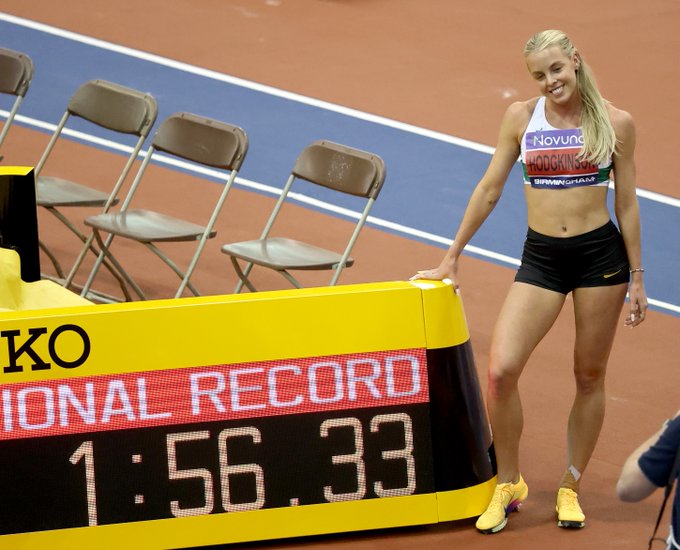
For British fans, this women’s 800m was unquestionably the headline act of the evening. Everything had been geared towards this assault on the record. Just days earlier in Birmingham, Hodgkinson had laid down a serious marker in her heat at the national championships, stopping the clock at a blistering 1:56.33 – at the time the third-fastest indoor performance in history. Remarkably, that run came without a pacemaker and without the assistance of wavelight technology. She then opted to skip the final to ensure she arrived in northern France fresh and primed for one purpose: rewriting the record books on one of the quickest indoor tracks in the world.
Inside the Arena Stade Couvert, Hodgkinson requested the wavelight be set two seconds inside the existing world record pace. The intent was clear. From the gun, she asserted control, moving straight to the front and handling perfectly the new regulation requiring athletes to break after the second bend rather than the first. She passed 400 metres in 55.56 seconds – a full second quicker than at Birmingham. The tempo was fierce, yet visibly controlled. There was no sense of panic, only precision.
At 600 metres, reached in 1:25.06, the race was already strung out. Switzerland’s Audrey Werro (PB 1:57.27) and Ethiopia’s Tsige Duguma (PB 1:58.35), her principal challengers on paper, were several metres adrift. Hodgkinson, by contrast, looked composed, driving her knees high and maintaining rhythm as she tracked the luminous green line circling the boards.
Entering the final lap, she was effectively racing the clock alone. Fatigue inevitably crept in, but she remained relaxed, shoulders low, stride length unwavering, glued to the wavelight set well beneath the Slovenian’s mark. The crowd sensed history. When she crossed the line in 1:54.88, the reaction was instant. The 24-year-old record – set on 3 March 2002, the very day Hodgkinson was born – had fallen. By nearly a second.
Earlier in the evening, the small British contingent had already played a lively role. The women’s 1500m, scheduled at 8:30pm local time, opened their account. Georgia Hunter Bell and Jemma Reekie lined up against a strong Ethiopian field. The race went out briskly before slightly settling, with 1,000 metres covered in 2:41 as the European record pace lights gradually drifted away.
At the bell, Hunter Bell produced a sharp injection of pace that ultimately carried her to victory. Her winning time of 4:00.21 was less than a second shy of the world-leading mark this season, though still over three seconds outside the European record she had tentatively targeted. Ethiopia’s Birke Haylom (4:01.17) and Saron Berhe (4:01.51) completed the podium, while Reekie placed fourth in 4:02.14, her fastest time of the year so far.
In the men’s 800m, Ben Pattison – the 2023 World Championship medallist outdoors – arrived with the second-best seasonal time among the entries. Content to sit off the early pace, he bided his time through 600 metres (1:18.72) before launching a powerful late surge down the home straight. His finishing speed was arguably the sharpest in the field, but he had left himself too much to do. Pattison had to settle for third in 1:46.03, behind Germany’s Alexander Stepanov (1:45.89, a personal best) and Croatia’s Marino Bloudek (1:45.93).
The women’s 2000m saw Australia’s Jessica Hull, hunting the world record, storm to victory in 5:26.68 – the second-fastest time in history behind the mark held by Genzebe Dibaba, which ultimately remained out of reach. Britain’s Revee Walcott-Nolan finished sixth in 5:35.87, breaking a long-standing British record dating back to 1993 – a noteworthy achievement, even if over a rarely contested distance.
Elsewhere, Portugal’s Isaac Nader claimed the men’s 1500m in 3:32.44, setting a new national record in the process. The 60m hurdles final provided one of the most extraordinary finishes of the night, with Spain’s Enrique Llopis and France’s Just Kwaou-Mathey inseparable on the line, both credited with 7.446 seconds and declared joint winners to the thousandth.