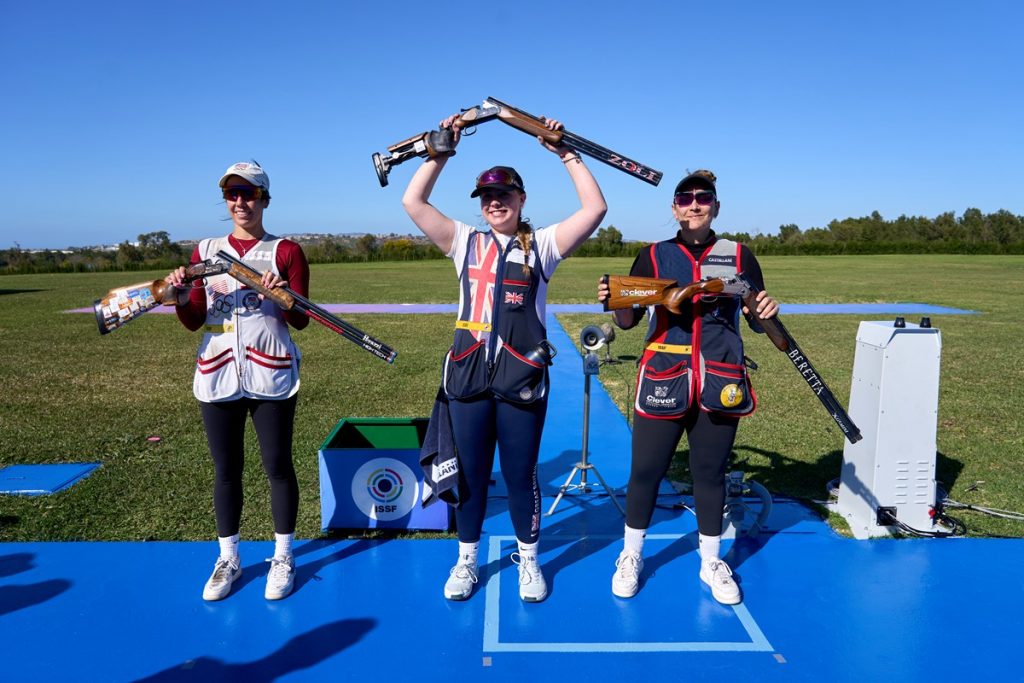
At just 19 years of age, Bethany Norton has already etched her name into the history of world shooting. By claiming victory at an ISSF World Cup leg in Tangier, the British shooter not only secured gold but also set a new junior world record. A landmark triumph that underlines the emergence of a major talent in a discipline where the United kingdom is increasingly asserting itself on the global stage.
A victory against the world’s elite
The stage was set: a World Cup final, eight of the finest shooters on the planet, and demanding conditions marked by strong winds and tricky light. In that context, Bethany Norton, aged just 19, was competing in her very first final at this level.
And the field she faced was stacked with experience. Several of her rivals had already claimed medals on the international stage. Slovakia’s Vanesa Hockova and Greece’s Emmanouela Katzouraki, both finalists at the Paris 2024 Olympic Games, stood out as leading contenders. American Dania Jo Vizzi, a regular on World Cup podiums, posed a constant threat, while France’s Lucie Anastassiou brought further pedigree as a multiple medallist on the ISSF circuit.
Under the ISSF’s elimination format, where each series sees a finalist knocked out until only two remain to contest the decisive head-to-head, Norton displayed remarkable composure. It is a format that ruthlessly exposes any lapse in concentration, yet the British stood out for her ability to repeatedly execute under pressure.
With a final score of 28, she not only secured the gold medal but also entered the record books with a junior world record.
By overcoming such a high-calibre field at just 19, Norton has placed herself firmly on an upward trajectory that could soon take her to the very top of international shooting. With the Los Angeles 2028 Olympic Games on the horizon, she now appears poised to arrive on that stage with an already significant résumé.
British shooting on the rise
Norton’s breakthrough does not come in isolation. It is part of a broader resurgence in British shooting, which has steadily rebuilt its presence at the highest level in recent years.
At the London 2012 and Rio 2016 Olympic Games, the British team secured medals notably in the double trap event, a discipline that has since been removed from the Olympic programme. By Tokyo 2021, Matthew Coward-Holley managed to get Britain to the Olympic podium in trap with a bronze medal, following in the footsteps of Edward Ling, who had achieved the same feat four years earlier.
Three years later, in Paris, that upward trend was emphatically confirmed. Nathan Hales delivered a gold medal in the men’s trap, setting a new Olympic record in the process and establishing himself as one of the discipline’s leading figures.
At the same time, women’s skeet has been a major focal point. Amber Rutter, one of the sport’s standout names, claimed silver in a final that remains highly controversial. During the decisive shoot-off, a shot that clearly hit the target was not awarded, ultimately denying her what seemed a certain Olympic title.
Like Amber Rutter before her—who made headlines by winning a World Cup event as a teenager—Bethany Norton reinforces Britain’s growing ability to produce elite-level shooters at a very young age. Her rise is not an isolated case, but part of a wider trend.
In 2024, Maddie Russell emerged as another leading prospect by becoming junior world champion in women’s skeet, following a composed and controlled performance in the final. Together, Norton and Russell represent a new generation already capable of delivering on the biggest stages.
With the experience of Amber Rutter, still one of the world’s leading figures in pursuit of Olympic gold, combined with the rapid emergence of Norton and Russell on the women’s side—and alongside a men’s trap squad that has now produced Olympic medallists across three consecutive Games, the United Kingdom currently boasts a depth of talent rarely seen in the sport.
As a result, British shooting approaches the coming years with genuine ambition. With multiple athletes now capable of targeting gold at major international competitions, the nation is well positioned as attention gradually turns towards the Los Angeles Olympic Games.