With the indoor season only just getting underway, some of Britain’s young prospects have wasted no time in shifting their focus towards the summer. Over the space of a few days, Rhian Mitchell and Michael Maguire have both achieved the qualifying standards for the European U18 Championships in Rieti, sending an early and encouraging message about the strength of the British pipeline. At the same time, the indoor sprint scene delivered one of its most compelling weekends of the winter, highlighted by the rise of Romell Glave and further confirmation of Jody Smith’s growing status on the international stage.
Mitchell and Maguire secure European U18 qualification
European U18 qualifying standards are never achieved by accident, and even less so at such an early stage of the season. Yet Rhian Mitchell and Michael Maguire have already ticked that box, each in their respective discipline, with performances that go well beyond a simple administrative benchmark.
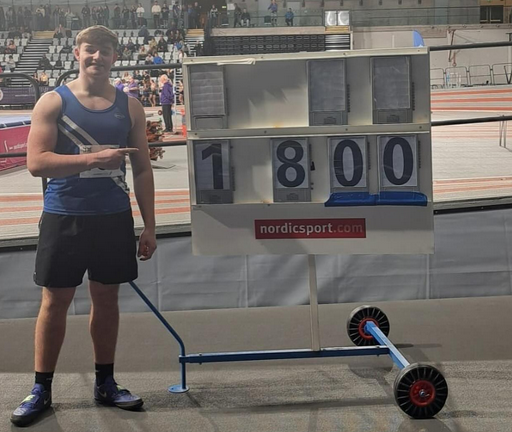
In Glasgow, 16-year-old Rhian Mitchell became the first British athlete this season to achieve the European U18 standard, producing a shot put throw measured at 18.00 metres. A mark of that level immediately places her among the very best in her age group, currently ranking fourth worldwide and third in Europe. She sits narrowly behind Italy’s Giuliano Pagot (18.10m), though still some way off the clear continental leader, Adrian Dral, whose 20.51m has set a formidable reference point.
Beyond the rankings themselves, Mitchell’s performance reflects a broader trend that has been quietly developing over recent seasons. British athletes are increasingly emerging in disciplines that were not traditionally seen as areas of strength, particularly in the throws and jumps. Mitchell’s throw fits squarely within that evolution, suggesting a depth of talent that continues to expand beyond the sprint and middle-distance events where Britain has historically excelled.
It is precisely in that same spirit that Michael Maguire produced the standout jump of his young career. Already responsible for several eye-catching jumps in recent weeks, the teenage long jumper confirmed at the Loughborough Flight Night that his form was anything but a flash in the pan. From his very first attempt, Maguire sailed out to 7.38 metres, comfortably surpassing the European qualifying standard of 7.20m by almost twenty centimetres. That jump alone was enough to secure his place for Rieti, but it proved merely the opening act of his evening.
A few rounds later, Maguire pushed the bar even higher with a superb leap of 7.47 metres, which currently stands as the world-leading U18 performance for the year. Two weeks earlier, he had already landed at 7.52m at a competition not listed on the World Athletics calendar. While that mark cannot be officially recognised as a world lead, it has nevertheless contributed to a growing awareness of his exceptional level. In a short space of time, Maguire has produced three competitions of outstanding consistency, repeatedly jumping beyond 7.40m.
Such repeatability at this age is rare, and it firmly establishes him as one of the most exciting prospects in European long jumping. It is also particularly significant in a discipline where British athletes have not reached the podium since Greg Rutherford’s European title in 2016. Maguire’s emergence therefore carries a broader resonance, hinting at the possibility of renewed British relevance in an event that has lacked major championship success in recent years.
Over 60 metres, Glave changes status, Smith delivers, Azu under pressure
While the younger athletes captured attention in the field events, the track offered an equally revealing spectacle in the sprints, with British men dominating the headlines over 60 metres at the BAUHAUS Indoor Gala.
Jody Smith, who had already impressed at the start of the indoor campaign, took another decisive step forward by winning the first heat in 6.61 seconds, finishing ahead of Italy’s Samuele Ceccarelli and Jamaica’s Rohan Watson. It was, without question, the biggest victory of Smith’s career to date, achieved against seasoned international opposition. The win underlined not only his improved speed but also his growing composure in high-quality fields, reinforcing the sense that his recent progression is both genuine and sustainable.
The main shock of the meeting, however, came from Romell Glave. In the heats, the Briton produced a stunning 6.55 seconds, a new personal best and a qualifying time for the World Indoor Championships, finishing ahead of reigning world indoor champion Jeremiah Azu. Even in isolation, that performance would have been enough to turn heads, but Glave was far from finished.
In the final, he delivered an even more emphatic statement, storming to victory in 6.51 seconds and once again lowering his personal best. Behind him, Azu clocked 6.54, while Olympic 100m silver medallist Kishane Thompson completed the podium in 6.56. Three athletes dipping under 6.60 in a single race underlined the exceptional quality of the contest, but the defining image was that of a British sprinter emerging victorious against some of the most established names in world sprinting.
For Jeremiah Azu, defeat does little to diminish the performance itself. His 6.54 represents his fastest season opener to date, six hundredths quicker than last year, and continues the upward trajectory that culminated in his world indoor title. Yet the balance of power is clearly shifting. Where Azu once stood largely unchallenged over 60 metres domestically, the internal competition has intensified sharply.
With Smith’s consistency — he also finished fourth in the final — and Glave’s explosive breakthrough, the British 60 metres scene suddenly appears more open than ever. Glave now sits third on the global rankings, a position that few would have predicted only weeks ago. The depth and rivalry developing within the squad could prove to be a decisive factor as the season progresses, potentially driving collective standards even higher in the weeks ahead.