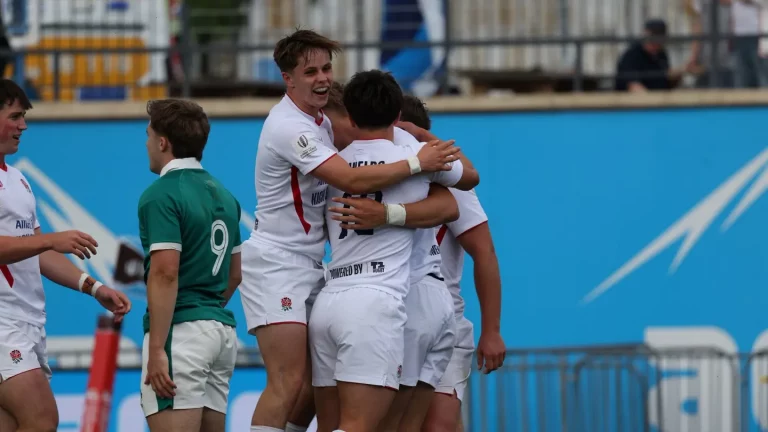
England U20 bounced back in style from their defeat against Ireland with a convincing 37–17 victory over Italy, securing a valuable bonus point in the process. Andy Titterrell’s side controlled large spells of the game in both possession and set-piece dominance, yet repeatedly frustrated themselves with a high number of knock-ons and squandered opportunities close to the Italian line. Despite those shortcomings, England’s depth and physical edge ultimately proved decisive in the final quarter, allowing the young Red Roses to pull away and claim a deserved win in Treviso.

Match report
From the opening minutes, England made their intentions clear. Much like in their previous outing against Ireland two weeks earlier, the young English side quickly seized the initiative, dominating territory and looking to impose a high tempo. An early penalty illustrated their attacking mindset: rather than opting for three points in front of the posts, Finn Keylock kicked to touch in order to set up a driving maul near the Italian try line. The visitors piled on pressure in the Italian 22 during the opening exchanges but were unable to convert their early dominance into points.
Indeed, England’s start was defined by a familiar frustration: the ability to create promising attacking situations, only to see them break down due to basic handling errors. On several occasions, offloads in contact slipped forward, gifting Italy relieving scrums at crucial moments. Eventually, that wastefulness proved costly. On one of their first meaningful visits to the English red zone, Italy capitalised on a five-metre scrum and quickly moved the ball wide to full-back Pietro Celi, who found the space to cross for the opening try of the match. Fly-half Francesco Braga added the conversion to put the Azzurrini 7–0 ahead, punishing an England side that had otherwise controlled much of the play.
Italy thought they had doubled their lead shortly afterwards through one of their most reliable weapons in this year’s tournament: the driving maul. After a lineout inside the England 22, hooker Valerio Pelli appeared to power over following a well-constructed maul. However, the try was eventually ruled out after the referee spotted an illegal obstruction from Carlo Antonio Bianchi in the build-up. The decision was consistent with an earlier call against England’s Tate Williams for a similar infringement, demonstrating a clear and fair interpretation of the law.
Despite the scare, England continued to threaten but struggled to eliminate the errors that had undermined their early momentum. Handling mistakes repeatedly halted promising attacking phases, allowing Italy to regroup defensively. Eventually, though, England’s territorial pressure began to pay dividends as the half approached its final stages. After earning a penalty close to the Italian line, scrum-half Lucas Friday took a quick tap and slipped the ball to Will Knight, who managed to control a tricky pass near the turf before grounding the ball for England’s opening try. Keylock’s straightforward conversion levelled the scores at 7–7.
Italy’s discipline began to unravel towards the end of the first half. Centre Luca De Novellis committed a series of infractions and was eventually shown a yellow card. This time England opted for pragmatism rather than ambition: instead of kicking to the corner again, Keylock calmly slotted a penalty in front of the posts to give England the lead for the first time in the match. At half-time, England were 10–7 ahead, though the overall impression remained that they had been the better side while still lacking the precision to fully capitalise on their superiority.
England started the second half in the ideal fashion, taking advantage of their numerical advantage while De Novellis was still in the sin bin. Following a scrum deep in Italian territory, the visitors launched a slick attacking move. Tyler Offiah first made ground down the touchline before captain Connor Treacey drew defenders in midfield. Scrum-half Lucas Friday then spotted a gap in the Italian defensive line and darted through to score a well-taken try, which Keylock converted to extend the lead to 17–7.
Italy responded almost immediately. A knock-on from England at the restart followed by a scrum penalty handed the hosts an opportunity inside the English 22. After several close-range phases, hooker Valerio Pelli forced his way over the line, though Braga was unable to add the conversion, leaving the score at 17–12. The match had become scrappy, with each side responding quickly whenever the other gained momentum.
England restored a measure of control thanks to Keylock’s reliable boot, the fly-half knocking over a penalty to stretch the lead back to eight points at 20–12. Yet another mistake under the high ball soon invited Italy back into the contest. Winger Malik Faissal capitalised on pressure applied to Lucas Friday, regathering the loose ball to score in the corner and bring Italy within three points once more (20–17).
Despite those nervy moments, England’s bench eventually began to influence the contest. Just after the hour mark, flanker Seb Kelly powered over following a chaotic attacking sequence. There had been brief confusion earlier in the move when substitute Jonny Weimann appeared to knock the ball forward, but the referee ruled the pass had travelled backwards, allowing play to continue and the try to stand. With the score now at 25–17, England regained a crucial cushion and confidence began to grow within the side.
Italy’s discipline, already shaky in the first half, deteriorated further in the closing stages. A succession of penalties allowed England to camp once again inside the Italian 22. From one such phase initiated by Jonny Weimann, Aiden Ainsworth-Cave managed to keep the ball alive before releasing Keylock, who crossed for the bonus-point try before calmly converting his own score to make it 32–17.
The final stages confirmed England’s growing dominance. Another scrum penalty provided a lineout platform, and the English pack executed a well-drilled driving maul to perfection. Replacement forward George Marsh, only recently introduced from the bench, was the man who eventually dotted down to seal the result at 37–17.
In the standings, England secure an ideal five-point haul that keeps them firmly in the hunt for the U20 Six Nations title. However, beneath the convincing scoreline lies a clear area for improvement. Andy Titterrell’s side produced plenty of attacking intent but were repeatedly undermined by basic handling errors and wasted opportunities. Against a more clinical opponent, such profligacy could prove far more costly — something England will need to address ahead of their possible decisive clash with France.