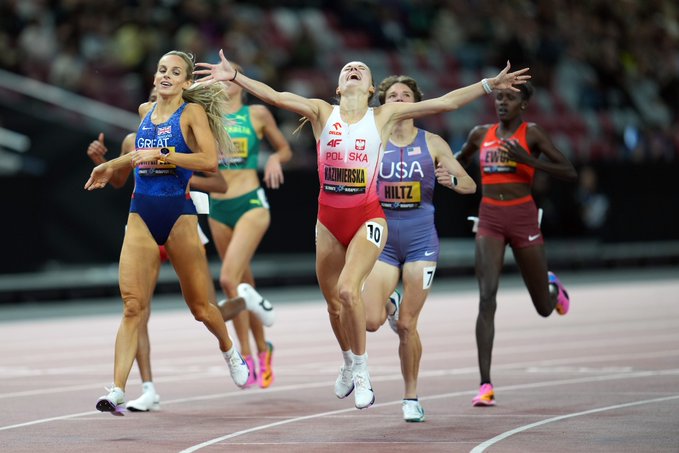
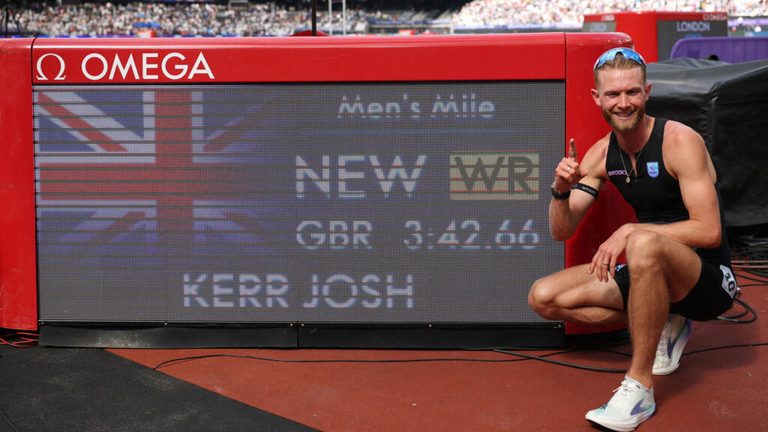
Josh Kerr, Georgia Hunter Bell, Molly Caudery and Keely Hodgkinson led the United Kingdom to a remarkable haul of four medals at the World Indoor Championships : all of them gold including three secured in the space of less than an hour during a stunning final evening. It was also a night that hinted at intriguing new possibilities for the future of British 4x400m relay teams.
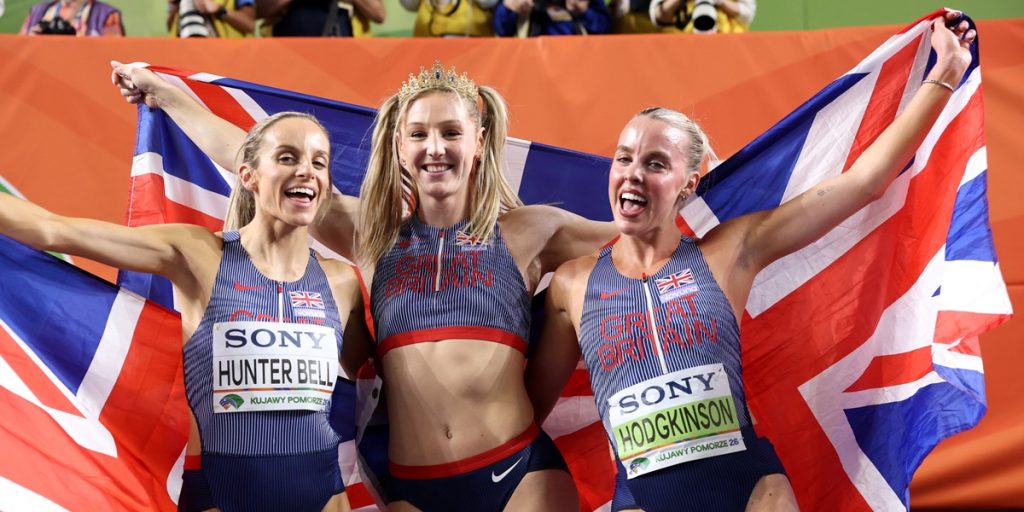
Four titles, three in an hour
The first of the four titles came courtesy of Edinburgh-based runner Josh Kerr, crowned world champion over 3000 metres in 7:35.56. In a tightly packed, highly tactical race — with seven athletes finishing within two seconds, Kerr judged his effort to perfection. Sitting around fifth for much of the contest, he waited until the final two laps to move into contention before unleashing a decisive surge at the bell, reminiscent of his outdoor world title run in 2023. The result : a perfectly executed final lap and a reclaimed world indoor crown, having already won the title in 2024.
However, it was on the final evening that the UK truly made its mark. Three gold medals in roughly an hour evoked memories of the iconic “Super Saturday” at the London 2012 Olympic Games. On 4 August 2012, the British team claimed six gold medals, three of them in athletics within 45 minutes — Jessica Ennis-Hill in the heptathlon, Greg Rutherford in the long jump, and Mo Farah in the 10,000 metres. In Toruń, a similar momentum took hold, sparked by the first women’s final of the night.
In the 1500 metres, Georgia Hunter Bell delivered a textbook performance. Faced with a blistering early pace set by Ethiopia’s Birke Haylom, she refused to be drawn into panic, instead maintaining composure at the head of the chasing group. Gradually, the gap began to close, and at the bell, Hunter Bell — alongside Australia’s Jessica Hull — positioned herself to strike. A sharp acceleration down the home straight proved decisive, as she powered clear to claim her first major international title in 3:58.53, a British record.
Moments later, the pole vault which had been unfolding throughout the evening reached its climax. Only Molly Caudery and Slovenia’s Tina Šutej remained, both flawless up to 4.80m. After a shared miss at 4.85m, Caudery responded at the second attempt, clearing the bar to seal victory. It was a near-perfect series and, like Kerr, it saw her regain a world indoor title she had previously won in 2024.
To round off the golden sequence, Keely Hodgkinson produced a commanding display in the 800 metres. Entering the race as the overwhelming favourite following her world record in Liévin, she took control from the gun and never relinquished it. Setting a relentless tempo from the outset, she shut down any tactical ambitions from her rivals. Her winning time of 1:55.30 — a championship record — underlined her dominance, finishing nearly 1.5 seconds clear of Switzerland’s Audrey Werro.
In the 60 metres, Jeremiah Azu came agonisingly close to the podium. Already impressive in the semi-finals with a personal best of 6.45, he backed it up in the final with 6.46. Yet in a race of extraordinary quality — 6.41 for the winner, 6.45 for both silver and bronze — it was not enough. Fourth place, just one hundredth outside the medals. Remarkably, that time makes him the fastest non-medallist in history over the distance, underlining the standard of the final. This, from the reigning world champion, who had taken gold in 2025 in 6.49.
A similar story unfolded for Scott Lincoln in the shot put. His mark of 21.13m, an indoor personal best, represents the best performance ever by a British athlete in a World Championships setting. However, in a competition won beyond 22 metres, he missed out on a medal by just 36 centimetres. Consistent and steadily improving, Lincoln continues to edge closer to the global elite.
The women’s 4×400 metres relay, meanwhile, offered a particularly compelling narrative. Fifth place in 3:28.09 may not stand out on paper, but the underlying performances tell a far richer story.
The surprise inclusion of Dina Asher-Smith and Keely Hodgkinson added an unexpected dimension. Hodgkinson recorded the fastest split of the entire final with a stunning 50.10. For context, most athletes clocked between 50.8 and 51.5 — with Rosey Effiong at 50.83 and Lieke Klaver at 51.16. The margin is significant.
That said, such comparisons require nuance. Unlike first-leg runners such as Klaver or Natalia Bukowiecka, who start from a standing position, Hodgkinson received the baton at speed, benefiting from a flying start. Naturally, this leads to faster splits, but it does not diminish the quality of her run — rather, it helps place the performance in proper context.
Dina Asher-Smith also impressed, posting a 51.29 split — the seventh fastest of the final. For an athlete whose primary events are the 100m and 200m, it was an excellent showing and further evidence of her versatility over one lap.
The gap, however, becomes more apparent with the other two legs. Louisa Stoney (52.96) and Tess McHugh (53.74), both competing in their first major international championship, recorded the 20th and 22nd fastest splits respectively. A deficit that reflects their inexperience at this level, and one that ultimately cost the team several seconds overall.
Even so, the relay offers genuine promise. With Hodgkinson emerging as a serious option for a flying 400m leg and Asher-Smith providing depth and quality, the United Kingdom now has new tactical configurations at its disposal. Surrounding these profiles with more experienced quarter-milers — such as Anning, the Nielsen sisters, Hudson-Smith or Dobson — could quickly elevate both the women’s and mixed 4x400m teams.
With the European Championships in Birmingham and the Commonwealth Games in Glasgow both scheduled for this summer, there may soon be an opportunity to see these ideas put into practice.