Following the opening titles won by Joseph Scanes and Divine Iheme during the first two days, Freddie Rowe, Tito Odunaike, Lucy Bull, Samuel James, Bronson Hearn-Smith and Moyo Stumpenhusen ensured the United Kingdom finished the European Athletics U18 Championships in Rieti at the top of the medal table. With eight European titles, 14 medals overall and five championship records, the British team produced one of its finest performances in the history of the competition, driven by remarkable depth across both the track and the field events.
British dominance built across every discipline
The opening two days had already provided the perfect platform thanks to Joseph Scanes’ victory in the 3000m and Divine Iheme’s 100m title, alongside Celine Obinna-Alo’s bronze medal in the women’s sprint. What followed only reinforced that momentum, as the British team delivered historic performances not only on the track but also in the jumps and throwing events.
Day three produced one of the most dramatic stories of the championships in the men’s 200m. Ethan Heggarty arrived as the overwhelming favourite after smashing the championship record with 20.77 in the heats. However, his campaign came to an abrupt end in the semi-finals after he was disqualified for a lane infringement. It was a devastating outcome for the British sprinter, who entered the championships as the world-leading U18 athlete over the distance and looked well placed to challenge for the title. The disappointment was made even greater by the fact that an Italian athlete in the same race was allowed to continue despite appearing to false start, a decision that inevitably prompted frustration within the British camp.
Fortunately for the United Kingdom, Bronson Hearn-Smith stepped up superbly. The second British athlete in the event seized his opportunity, producing the race of his life to win the final in 20.70. In doing so, he lowered the championship record once again and secured another gold medal for the British team in impressive fashion.
Moments later, Moyo Stumpenhusen confirmed his status as the favourite in the men’s discus. Already Europe’s leading U18 thrower before arriving in Rieti, the British team captain launched a national U18 record of 64.92m to secure the continental title. It also represented the best British result in the event at a European age-group championships for well over a decade.
The day concluded with arguably one of the standout performances of the entire championships. Samuel James cleared 2.15m, 2.18m, 2.21m, 2.23m and finally 2.25m in the high jump to claim gold. As well as setting a new championship record, the clearance equalled Steve Smith’s long-standing British U18 record, which had stood for 36 years. The scale of the achievement becomes even more remarkable considering James had arrived in Rieti with a personal best of just 2.09m, while Poland’s Dawid Barański, who claimed silver, managed “only” 2.12m.
The final day simply reinforced the extraordinary depth of this British generation. Tito Odunaike claimed the men’s triple jump title with a leap of 16.12m, equalling his personal best, matching the world U18 lead and setting yet another championship record. In doing so, he became the first British athlete ever to win the European U18 triple jump title.
Lucy Bull continued the celebrations by taking gold in the women’s javelin with a personal best throw of 56.60m. Having remained unbeaten throughout the 2026 season, she produced her finest throw when it mattered most to become the first British European U18 champion in the event. It was also one of the closest contests of the championships, with Bull securing victory by just 20 centimetres.
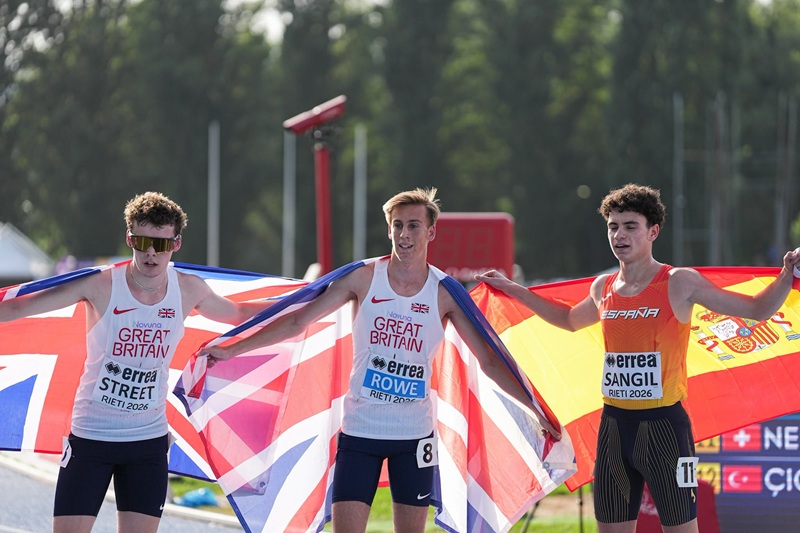
In the men’s 1500m, Freddie Rowe delivered another tactically mature performance, waiting until the final 200 metres before producing his trademark finishing kick to secure gold. Fellow British athlete Alistair Street completed a memorable one-two by taking silver, marking the first British one-two in the event in the history of the European U18 Championships.
The remaining medals further highlighted the strength of the squad. Ned Scott collected silver in the men’s javelin with a personal best of 70.02m, while Oliver Downs became the first British decathlon medallist at a European Championships, across any age group, since Daley Thompson after taking bronze with a new British record of 7,341 points. Lucia Bertacchini also earned an excellent bronze medal in the women’s 400m hurdles despite being handed a particularly unfavourable lane. Her performance capped a championships during which several British athletes repeatedly found themselves allocated outside lanes despite producing qualifying performances that appeared deserving of more favourable draws.
Beyond the medal count, these championships also highlighted the remarkable progress made by British athletes in the field events. Traditionally recognised for its strength in sprinting and middle-distance running, the British team returned home with titles, records and podium finishes in the discus, javelin, high jump, triple jump and combined events. Sophie Robertson’s fifth place in the hammer throw, Emilia Adese’s fourth place in the shot put, Leila Newth’s fourth-place finish in the triple jump after breaking the British U18 record multiple times, and Dionne McGuinness’ sixth place in the heptathlon, where she also set a new Scottish record, all demonstrated the growing strength and depth of British field event athletes.
At the conclusion of the four days of competition, the United Kingdom comfortably topped the medal table with eight gold medals, two silvers and four bronzes, giving the team a total of 14 medals. Even more impressively, five of those eight European titles — won by Divine Iheme, Bronson Hearn-Smith, Samuel James, Tito Odunaike and Moyo Stumpenhusen — came alongside new championship records, underlining the outstanding standard produced by this exceptional generation of British athletes and confirming the excellent health of British athletics at U18 level.