He was seen as the standard-bearer for the resurgence of British sprinting. In the space of a few short months, Louie Hinchliffe went from promising prospect to NCAA champion and Olympic medallist. Then, almost as swiftly, his trajectory became clouded by injuries and a hasty career decision. Eighteen months after leaving the American collegiate circuit to turn professional, the Sheffield sprinter has performed a U-turn. His destination: Texas, and a return under the guidance of Carl Lewis at the University of Houston.
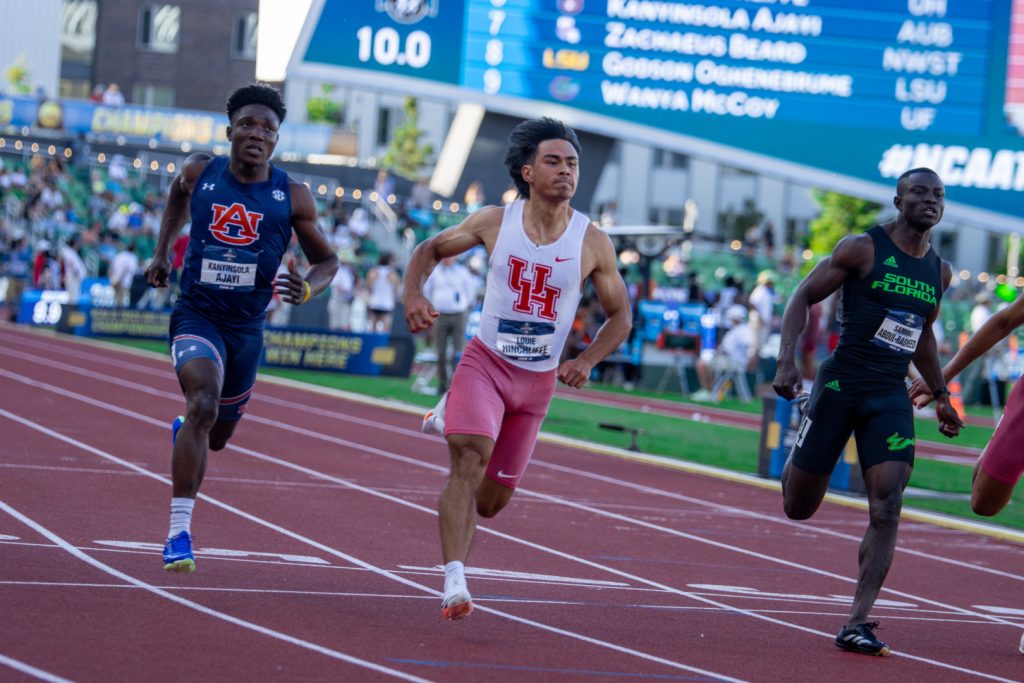
Hinchliffe’s progression on the clock since the early days of his career has been bordering on the surreal. Back in 2019, aged 17, he clocked 11.00 seconds in the 100 metres at the English Schools Championships. Five years later, he was standing atop the podium in Eugene, having become the first European in history to claim the NCAA 100m crown in 9.95 seconds.
The incremental improvements tell their own story: 10.60 in 2021, 10.30 in 2022, 10.17 in 2023, before the breakthrough campaign of 2024. That year, following his transfer to Houston, he moved into a different gear under the stewardship of Carl Lewis — one of the greatest sprinters the sport has ever known, who has proven equally adept as a coach. In May 2024, Hinchliffe posted a wind-legal 10.00 seconds, followed by a 9.84 with slight assistance. Weeks later, on the hallowed track at Hayward Field in Eugene, he stormed to the NCAA title in 9.95 (+0.2), catapulting himself into the top ten fastest Britons of all time.
Momentum carried him straight into the British Championships in Manchester, where he completed a rare double — NCAA champion and national champion in the same season. Selected for the 2024 Summer Olympics, Hinchliffe dipped under ten seconds twice in the heats and semi-finals, even getting the better of eventual Olympic champion Noah Lyles in the opening round. Despite clocking 9.97 seconds, he narrowly missed out on an individual final berth. Yet he left Paris with an Olympic bronze medal as part of Great Britain’s 4x100m relay quartet — his first senior international podium and tangible proof that he belonged on the global stage.
At 22, the path ahead seemed perfectly aligned. Buoyed by his breakthrough season, Hinchliffe opted to leave the collegiate system and turn professional, linking up in the UK with former world indoor 60m champion Richard Kilty. The move was rooted in shared philosophy and approach. But elite sport can be unforgiving. His 2025 season was disrupted by a stress fracture and persistent hamstring problems. His fastest 100m of the year, 10.08, was a far cry from the heights of 2024. Suddenly, the horizon darkened.
A Return to Familiar Ground Under Carl Lewis
In late February 2026, confirmation arrived: Hinchliffe had been cleared by the NCAA to regain student-athlete status. After navigating a thorough reinstatement process, he re-enrolled at the University of Houston and reconnected with his former mentor, Carl Lewis.
Within the American system, turning professional is often perceived as a point of no return. To retrace one’s steps and publicly acknowledge a misjudgement requires humility and clarity of thought. Lewis was candid in his assessment, telling the Texas press: “For our programme, it’s like getting a huge free agent back.” He added: “He said to me, ‘I made a mistake, I’m sorry — can I come back ?’ He owned it. I’m really proud of him for that.”
Those words underline the depth of trust between athlete and coach. Back in 2024, Hinchliffe had already spoken glowingly of Lewis’s influence — particularly his ability to pass on the wisdom of a nine-time Olympic champion while maintaining a disciplined, structured environment.
The early signs on the track have been encouraging. Competing at the Big 12 Indoor Championships in Lubbock, Hinchliffe clocked 6.62 seconds in the 60m heats to secure a place in the final. On paper, a respectable mark. In reality, a telling one: four hundredths quicker than his best time from the 2024 indoor season, achieved in his very first outing of the year. In 2023, he had exploded to a lifetime best of 6.60. The foundations of raw speed remain intact — and there is every indication that a personal best could fall in the coming weeks.
Medium term, the objective is clear: the Los Angeles 2028 Olympic Games. British sprinting, spearheaded by Zharnel Hughes and Jeremiah Azu, requires depth if it is to consistently challenge for global medals. Hinchliffe, the sixth-fastest British man in history over 100m, belongs to the cohort capable of reaching world finals or forming a formidable relay unit.
As early as this summer, major fixtures such as the Commonwealth Games or the European Championships in Birmingham could offer him the platform to reassert himself on both continental and global stages — and perhaps climb back onto a major championship podium.