As the 2026 Six Nations approaches, England are entering a new cycle with a level of squad depth rarely seen in recent years. While certain hierarchies already appear well established, other positions remain wide open to competition, particularly across the back three. And among the players banging loudly on the door of the senior squad, one name is being mentioned with increasing regularity: George Hendy. Still uncapped at Test level, the versatile Northampton Saints back has nevertheless emerged as one of the Premiership’s standout performers this season.

George Hendy: a low-key education before the Northampton breakout
Very little suggested that George Hendy would, at 23, be one of the most closely watched young backs in English rugby. Born in Warwick in October 2002 and developed largely away from the spotlight in Warwickshire, Hendy was never labelled as a prodigy. Educated at King Edward VI School in Stratford-upon-Avon, he split his time between rugby, athletics and cricket, forging early on a well-rounded athletic profile and an intelligent feel for the game.
It was at Shipston-on-Stour, his local club, that Hendy quietly climbed through the age groups, eventually captaining the Colts. Used primarily at fly-half or centre in his youth, he gradually transitioned towards the back-field as he moved closer to senior rugby. Spotted by Worcester Warriors before being picked up by Northampton Saints following Worcester’s collapse, Hendy joined the Saints’ academy and signed his first professional contract in August 2021.
His rise was steady rather than spectacular, but crucially, never rushed. From his earliest senior appearances, Hendy showed a striking level of efficiency: five tries in his first nine outings, followed by a growing influence within Northampton’s rotation.
The 2023–24 campaign proved to be a first real breakthrough. Starting the opening five Premiership matches, Hendy made his mark domestically before announcing himself on the European stage. Two tries against Munster in the Champions Cup, followed by another influential display despite defeat to Leinster, firmly placed him on the radar. The high point came at Twickenham: a Premiership final victory over Bath, where Hendy was named Man of the Match, underlining his growing importance in a Saints side brimming with quality.
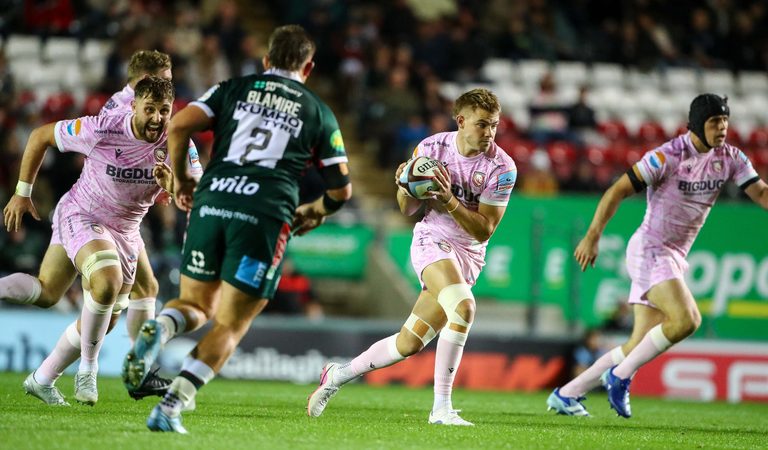
This season, Hendy has taken yet another step forward. Deployed on the wing or at full-back, he has thrived in Northampton’s attacking framework, already crossing for eight tries, six of them in his last three matches alone. His ability to rack up over 100 metres ball in hand, repeatedly hit sharp lines and finish clinically has earned him a flattering nickname in the English press: “The Ginger Penaud.”
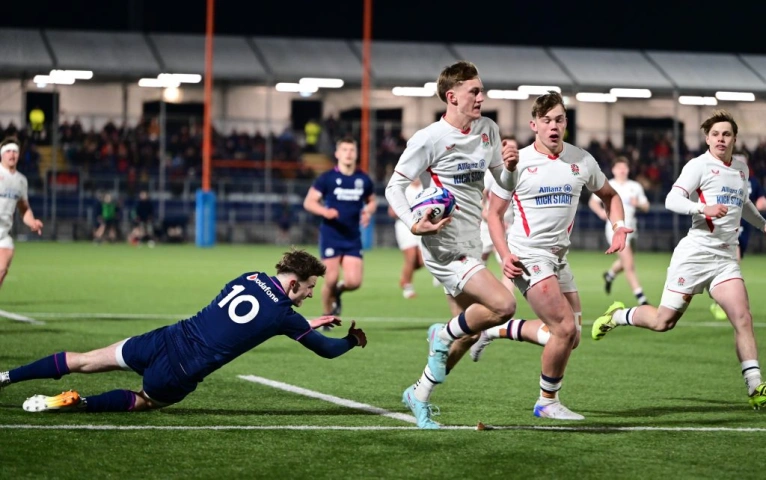
Already capped at Under-20 level and having featured for England A, Hendy has little left to prove domestically. The question now is whether Steve Borthwick is ready to hand him his first opportunity on the biggest stage.
Fierce competition, but doors still open at Test level
If George Hendy has yet to earn a senior England call-up, it is not due to a lack of quality, but rather the sheer depth available in his preferred positions. Wing and full-back are both areas where England are blessed with options – albeit not without a few selection headaches.
On the wing, Immanuel Feyi-Waboso looks close to undroppable. Barring injury, the Exeter man is expected to start, his blend of power, pace and direct running adding a unique edge to England’s attack. Tommy Freeman, another Northampton stalwart, is also all but guaranteed a place in the Six Nations squad, even if his exact role remains unclear. Equally comfortable on the wing or at outside centre – where he has excelled this season – Freeman’s positioning could prove decisive in shaping the wider back-three selection.
Behind them, the picture becomes far more fluid. Henry Arundell, despite limited involvement since his return to England with Bath, remains a likely inclusion thanks to his pace and finishing instincts. Tom Roebuck, impressive on previous tours and particularly valuable in the aerial contest – a key component of Borthwick’s tactical blueprint – is pushing hard for a starting role, though his ambitions hinge on a full recovery from a foot injury. Further down the pecking order, the likes of Noah Caluori and Adam Radwan harbour outside hopes of selection, but currently sit some distance from the front of the queue.
It may therefore be at full-back where Hendy’s clearest pathway lies. George Furbank, his club-mate at Northampton, currently leads the race thanks to his kicking game and creative influence, both well aligned with England’s attacking principles. However, his unfortunate history with injuries raises doubts over long-term availability. Freddie Steward, meanwhile, remains one of the game’s best under the high ball and a master of territorial control, but his selection often depends on the specific tactical demands of the opposition, despite notable improvements in his all-round attacking game.
In that context, Hendy profiles as a genuine hybrid option: reliable under pressure, yet capable of offering real attacking punch from deep. His versatility, current form and – perhaps most importantly – his natural chemistry with the Northampton core of the England squad all work strongly in his favour. Alex Mitchell, Fin Smith, Fraser Dingwall, Tommy Freeman, George Furbank, Alex Coles and Henry Pollock are all expected to feature in the Six Nations setup, some as starters, others as impact replacements.
Surrounded by familiar faces and thriving in a system that closely mirrors England’s attacking framework, George Hendy no longer looks like an outsider. Instead, he is fast becoming a logical, credible option – and potentially one of the most intriguing selection calls of the 2026 Six Nations.